
Marketplace Retirement Income in 2 Hours for Women 45–65, No Following
The most practical income streams in retirement for women who don’t want to chase a following are low-maintenance digital methods: printables, templates, memberships, and affiliate content built on marketplaces that already have buyers. The launch path is a focused 2-hour/day workflow, not a full-time hustle. Expect a slow build, not overnight income. Momentum for most sellers who publish consistently tends to show up around month three.
TL;DR:Building a digital shop with printables, memberships, or affiliate content typically takes three months of consistent publishing before noticeable momentum occurs.Starting with one method avoids spreading effort too thin, and maintaining a daily two-hour workflow with planning, building, and publishing maximizes productivity.Marketplace platforms like Etsy and Gumroad require minimal upfront investment, relying on platform traffic rather than personal followings to generate sales.Combining self-built online income streams with traditional retirement sources provides more flexible and sustainable financial security in later years.Success depends on effort and persistence, with gradual growth achieved through adding new listings and optimizing existing ones, rather than waiting for one product to sell.
Freedom After 45Build Your Two-Hour Income WorkflowFreedom After 45 provides a step-by-step 2-Hour Workflow blueprint for women over 45 seeking recurring income without an existing following.Explore the 2-Hour Workflow
Table of Contents
- What Are the Best Income Streams for a 2-Hour-a-Day Schedule?
- The 2-Hour Workflow: A Day-by-Day Blueprint to Launch Your First Income Stream
- How Do You Pick the Right Method for Your Life?
- Common Mistakes That Slow Down New Sellers
- What Traditional Retirement Income Streams Look Like
- How Are Different Retirement Income Streams Taxed?
- What Role Does Investment Income Play?
- Can Rental Property Provide Reliable Retirement Income?
- How Do You Withdraw From Retirement Accounts Without Running Out of Money?
- Why Midlife Experience Is an Advantage, Not a Setback
- How Freedom After 45 Turns This Plan Into a Repeatable System
- Sources
- FAQ
What Are the Best Income Streams for a 2-Hour-a-Day Schedule?
Five methods consistently work for women starting from zero audience and zero existing following. Each fits inside a short daily block because the heavy lifting happens once, up front, and the income keeps arriving on its own after that.
- Digital products (printables, planners, checklists, workbooks): You design once, list on a marketplace, and it sells repeatedly with no reprint or shipping. Startup in a single 2-hour session might mean sketching one planner in Canva and writing the product description. First-month focus is publishing a few listings; the three-month focus is refining titles and tags based on what actually clicks.
- Paid memberships or communities: A small recurring group (a private newsletter, a resource vault) built around one niche you already know well. Upkeep is light once the welcome sequence is written, but it needs steady, if brief, attention to stay valuable. Start by drafting the offer and a single onboarding email; by month three, aim for a handful of paying members rather than dozens.
- Affiliate content: Reviews, comparison posts, or resource pages that link to products you’d recommend anyway. This suits people who like to write and can be built almost entirely in short sessions. A realistic guide to affiliate income frames it correctly: a long-term, trust-based habit, not a shortcut.
- Print-on-demand: Designs applied to mugs, shirts, or tote bags through a production partner who handles printing and shipping. Your two hours go into design and listing, not fulfillment.
- Microservices packaged as templates: If you have a work skill (bookkeeping spreadsheets, resume formats, meal plans), package it once as a downloadable template instead of selling your time hour by hour.
Pick one. Trying two or three at once is the fastest way to make no progress on any of them.
The 2-Hour Workflow: A Day-by-Day Blueprint to Launch Your First Income Stream
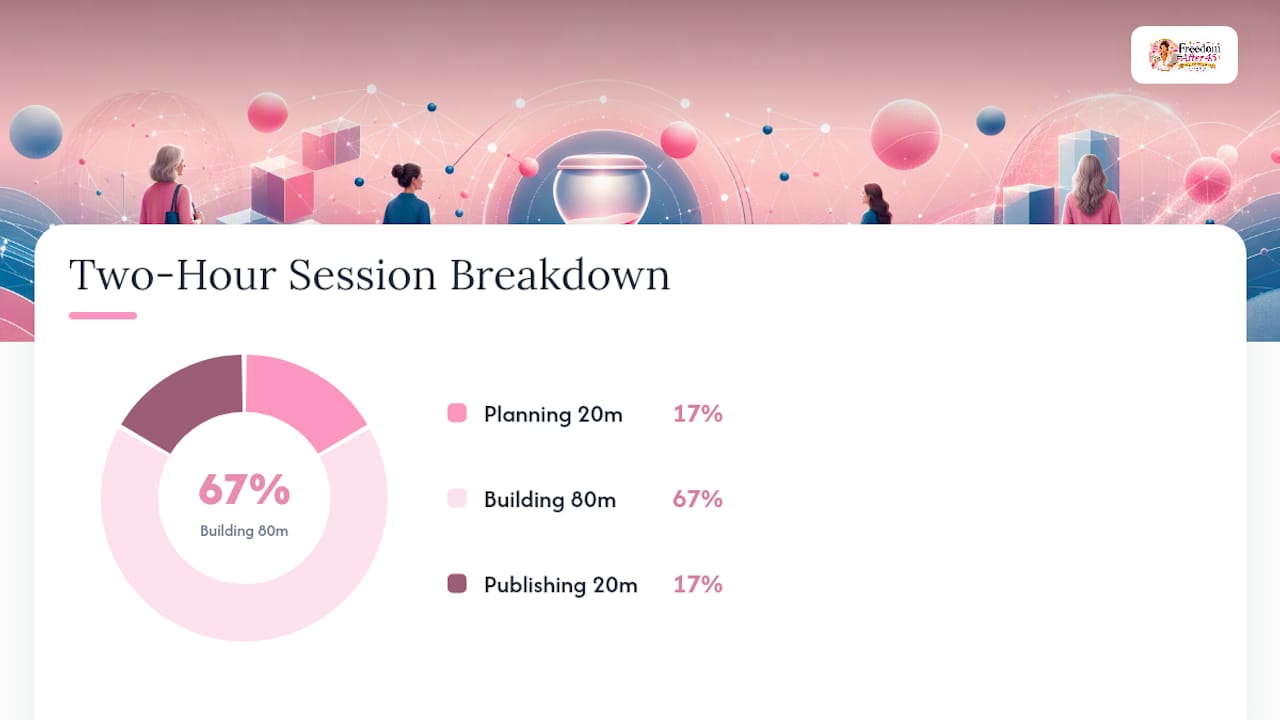
Every session follows the same three-part shape: 20 minutes of planning or research, 80 minutes of building, 20 minutes of publishing or promoting. That rhythm keeps two hours from turning into an unstructured afternoon.
A sample 14-day plan for a first digital product looks like this:
- Days 1 to 2: Pick one niche idea based on something you already know. Sketch the product concept and check two or three similar listings for pricing.
- Days 3 to 5: Draft the content. If it’s a planner or checklist, build the layout in Canva; if it’s written, draft the text with an AI writing assistant to speed up the first pass.
- Days 6 to 7: Format and proof the final files. Export in the sizes your marketplace requires.
- Days 8 to 9: Write the listing: title, description, tags, and preview images.
- Days 10 to 11: Publish on your chosen marketplace and set pricing.
- Days 12 to 14: Draft two more listings using the same template, then share the shop link with your existing personal network or email list.
One seller who started at 66 built a profitable Etsy shop this way, using ChatGPT for copy and basic design tools for artwork, then adding listings consistently until sales climbed. That pattern (publish, wait, add another, repeat) shows up across most beginner success stories in this space, and timeline data on printable shops backs it up: momentum tends to build by month three when sellers keep publishing.
Pro Tip: Batch your listing photos on day one of each new product cycle. Shooting five product mockups in one sitting saves more time than doing one at a time across five separate sessions.
Marketplaces with built-in traffic, like printable shops, KDP, or Gumroad-style platforms, mean you’re not responsible for driving your own visitors from day one.
How Do You Pick the Right Method for Your Life?
Run a three-question filter before committing to anything:
- What do you already know? Teaching, healthcare, bookkeeping, home organization, and craft skills all translate into credible digital products faster than starting from a blank slate.
- Do you have any existing audience? Even a small email list, a church group, or a neighborhood network gives affiliate content or memberships a head start that cold-start sellers don’t have.
- How much ongoing upkeep can you handle? Digital products and print-on-demand run mostly on autopilot after launch. Memberships need a monthly touchpoint. Affiliate content needs occasional updates to stay relevant.
Some practical pairings: a retired teacher tends to do well with printable lesson plans or study guides. A former nurse or caregiver often has an audience for wellness checklists or caregiving templates. Someone who loves research and writing usually fits affiliate content better than product design.
Minimal toolkit to learn in one two-hour session: a free design tool like Canva, one marketplace account (Etsy, Gumroad, or Amazon KDP), and a basic AI writing tool for drafting descriptions.
Red flags that suggest picking a different method: if you dread writing, skip affiliate blogging. If you can’t commit to a monthly check-in, skip memberships. If the idea of designing anything visual makes you want to quit, printables might not be your lane, and a template-based microservice could fit better.
Common Mistakes That Slow Down New Sellers
The most common early mistake is publishing one product and waiting for it to sell instead of adding more listings. Sellers who saw sales growth consistently kept publishing rather than perfecting a single item; that pattern shows up clearly in shops that scaled past their first few months.
A quick fix checklist for existing listings: rewrite titles to match how buyers actually search, add three to five more preview images, and update tags every few weeks based on what’s ranking.
Once something starts selling, scale carefully instead of overhauling everything at once:
- Add related products to the same shop (a second color, a bundle version, a companion checklist).
- Bundle two or three top sellers together at a slight discount.
- Set up one simple automated email that goes to buyers after purchase, offering a related item.
Pro Tip: Outsource only after a product proves it sells. Paying someone to design your fifth listing makes sense; paying someone to design your first one, before you know what customers want, usually doesn’t.
What Traditional Retirement Income Streams Look Like
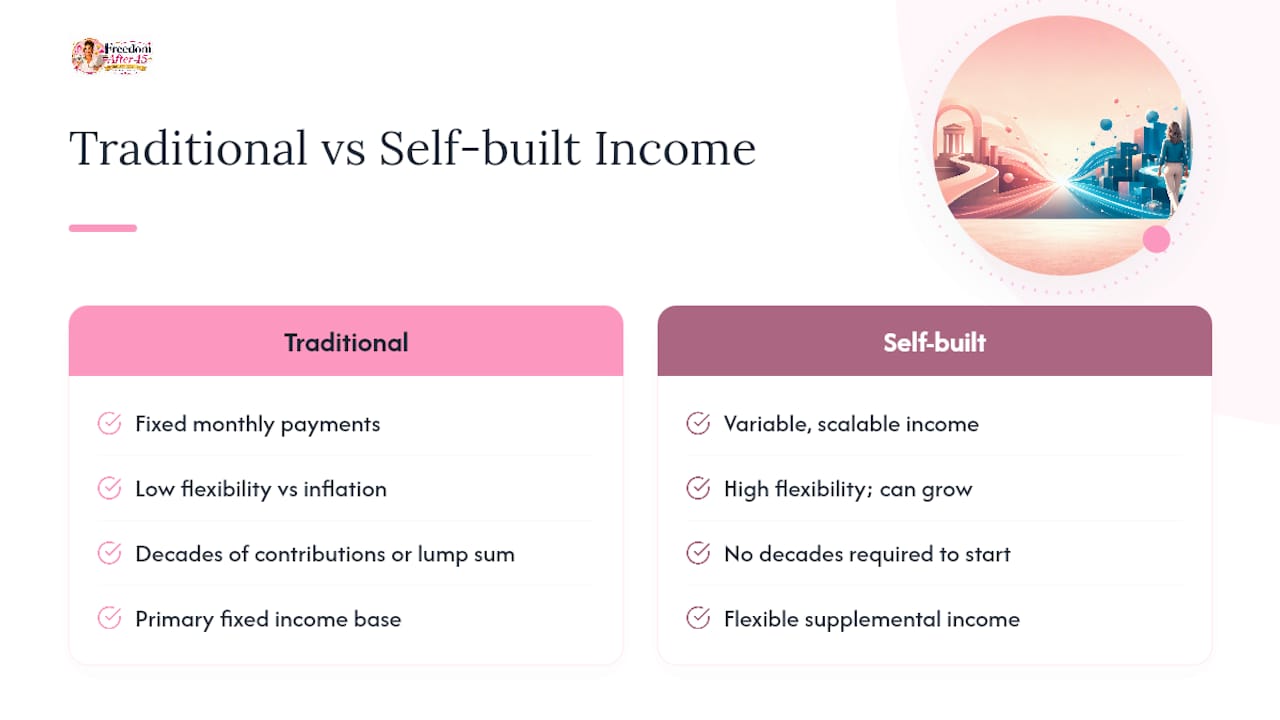
Most retirement planning still centers on three traditional sources: Social Security, pensions, and annuities. Social Security provides a monthly benefit based on your earnings history, and the amount depends heavily on the age you claim it. Pensions, where still offered, pay a fixed monthly amount from a former employer, though they’ve become far less common outside government and union jobs. Annuities are insurance contracts that convert a lump sum into guaranteed periodic payments, often used to cover essential expenses a person doesn’t want tied to market swings.
These traditional streams share one trait: they’re largely fixed once set up. That stability is valuable, but it also means they don’t flex much if inflation runs hot or if you want extra income for a specific goal, like travel or helping family. They also typically require either decades of prior contributions or a sizable lump sum to purchase, which isn’t an option for everyone approaching retirement with limited savings.
That gap is exactly where a self-built, low-cost online income stream earns its place. It doesn’t replace Social Security or a pension. It adds a flexible layer that you control, that can grow over time, and that doesn’t require decades of prior setup to start. For many women weighing their options in their late 40s through 60s, this combination (a fixed traditional base plus a self-built digital income stream) offers more actual security than depending on any single source.
How Are Different Retirement Income Streams Taxed?
Every income source in retirement carries its own tax treatment, and mixing them up leads to unpleasant surprises at filing time. Social Security benefits can be partially taxable depending on your combined income, but they’re never taxed at the same rate as ordinary wages. Traditional pension payments and withdrawals from tax-deferred retirement accounts, such as a traditional 401(k) or IRA, are generally taxed as ordinary income in the year you receive them, since you didn’t pay tax on that money going in.
Income from a self-built online business, whether it’s digital product sales, affiliate commissions, or membership fees, is generally treated as self-employment income. That means it’s subject to both income tax and self-employment tax, and you’re responsible for setting aside a portion of what you earn rather than having it withheld automatically. Keeping simple records of expenses (marketplace fees, design software subscriptions, a portion of your internet bill) helps offset that tax burden, since legitimate business expenses reduce your taxable income.
Investment income, like dividends and interest, follows its own rules. Qualified dividends and long-term capital gains typically get more favorable tax rates than ordinary income, while interest income and short-term gains are taxed at your regular rate. None of this replaces a conversation with a tax professional about your specific situation, especially once you’re combining several income types in the same year. But knowing that a digital income stream falls under self-employment rules, rather than passive investment rules, helps you plan realistically from day one.
What Role Does Investment Income Play?
Dividends, interest, and capital gains form the traditional backbone of a retirement income portfolio, and they work fundamentally differently from a paycheck or a self-built business. Dividends are payments companies distribute to shareholders, often quarterly, and many retirees favor dividend-paying stocks specifically because the payout continues regardless of daily price swings. Interest comes from holding bonds, certificates of deposit, or high-yield savings accounts, and it tends to be more predictable but generally offers a lower return than stocks over time.
Capital gains, the profit from selling an investment for more than you paid, only become income when you actually sell. That timing flexibility is useful: you can choose which year to realize a gain based on your tax situation, something you can’t do with Social Security or a pension payment.
The tradeoff with investment income is that it depends on market performance and on having enough capital invested to generate a meaningful amount. A $200,000 portfolio yielding 3% in dividends produces $6,000 a year, useful, but rarely enough on its own. That’s precisely why a self-built digital income stream complements rather than competes with an investment portfolio: it doesn’t require existing capital to start, and its growth potential depends on your own effort rather than market conditions you can’t control.
Can Rental Property Provide Reliable Retirement Income?
Rental property is a common traditional income stream, and it can produce steady monthly cash flow if the numbers work and you have reliable tenants. But it comes with real friction that often goes underdiscussed: mortgage or purchase costs, property taxes, maintenance, insurance, and the ongoing work of finding and managing tenants, or the cost of paying a property manager to do it for you.
Real estate also ties up significant capital, and it’s illiquid. Selling a rental property to access cash takes months, not days, unlike an investment account or a digital product shop where income keeps flowing without a large upfront purchase. For someone entering retirement without a substantial amount to invest in a down payment, rental property simply isn’t accessible in the way a digital income stream is.
That’s an important contrast worth sitting with: a printable product shop or an affiliate content site can be started for the cost of a marketplace listing fee and a design subscription, often under $50 total. A rental property typically requires tens of thousands of dollars in capital before it generates a single dollar of income. Both can work as part of a diversified income picture, but they serve very different starting points financially.
How Do You Withdraw From Retirement Accounts Without Running Out of Money?
The core challenge with retirement account withdrawals is pacing them so your money lasts as long as you do, without knowing exactly how long that will be. A commonly cited starting point is withdrawing around 4% of your total balance in the first year, then adjusting slightly for inflation each following year, though this rule works best as a rough guide rather than a fixed formula, since market conditions and your own spending needs shift over time.
Required minimum distributions add another layer: once you reach the age set by current tax law, you’re required to withdraw a minimum amount annually from traditional retirement accounts, whether you need the income or not, and failing to do so triggers a penalty. Knowing that date in advance lets you plan withdrawals strategically in the years before it arrives, potentially converting some funds to a Roth account earlier when it makes sense for your tax bracket.
Having a second income stream that doesn’t depend on account withdrawals gives you more control over this pacing. If a market downturn hits in a year you’d normally withdraw a set percentage, income from a digital product shop or a membership base lets you pull less from your investments during that specific stretch, giving your portfolio time to recover instead of locking in a loss.
Why Midlife Experience Is an Advantage, Not a Setback
Women starting an online income stream in their late 40s, 50s, and 60s bring something a 22-year-old creator doesn’t have: decades of domain knowledge people trust. That’s a real edge in a niche product or a recommendation.
Leadership voices are moving away from grind culture toward steady, authentic effort, and that fits this approach naturally. You don’t need to hustle nonstop. You need to finish one small project, publish it, and build from there.
— Freedom After 45
How Freedom After 45 Turns This Plan Into a Repeatable System
Freedom After 45 built the 2-Hour Workflow specifically for women who want a structured plan instead of piecing one together from scattered articles. The blueprint gives you step-by-step session templates, so instead of guessing what to do with your two hours each day, you follow a set sequence built around launching a real digital income stream.

The program includes video walkthroughs, instructional content, and access to a support community, providing guidance when a listing underperforms or a template needs adjusting. It’s built for women 45 to 65 who want hands-on structure and don’t want to start from a blank page. If the idea of a guided, weekend-friendly launch plan sounds more workable than building everything from scratch, explore the 2-Hour Workflow and see whether it fits your next step.
Sources
Relying on one income source in retirement means one disruption (a market downturn, a delayed benefit, an unexpected expense) can hit your entire budget at once. Diversification spreads that risk across sources that don’t move in the same direction at the same time.
A diversified retirement income picture typically blends a fixed baseline (Social Security, a pension if you have one) with market-linked income (dividends, interest) and at least one self-directed stream you can control day to day. The self-directed piece matters more than people assume: unlike Social Security or a pension amount, an online income stream is something you can actively grow through your own effort, whether that means adding new digital products or expanding a small membership base.
If a portion of that income instead comes from a digital product shop or a membership that keeps generating sales independent of the stock market, that pressure eases considerably.
Start small. Even a modest secondary stream, built through consistent effort over several months, reduces how much weight falls on any single source. The women launching businesses later in life are, in effect, building exactly this kind of diversification, using transferable skills rather than starting from scratch.
- Selling Digital Products with AI for Retirees 2026
- How a 66-Year-Old Mom and Grandma Built a Thriving Etsy Shop Using AI
- Why top leaders are ditching hustle culture for something else — Entrepreneur
FAQ
How long until a new digital product shop earns real money?
Most sellers who publish consistently see early momentum after several months, with meaningful traction building as listings accumulate.
Do I need a social media following to start?
No. Marketplace-based methods like printable shops, KDP, and Gumroad rely on the platform’s own traffic rather than your personal audience.
Which method works best if I have no design skills?
Affiliate content or written digital guides suit non-designers better than printables or print-on-demand, since the core work is writing rather than visual layout.
Is income from an online shop guaranteed?
No. Results vary by effort, niche, and consistency, and there’s no guaranteed earnings outcome. Freedom After 45’s blueprint gives structure and templates, not a promise of a specific income.
How does Freedom After 45’s program fit into this plan?
It packages the 2-hour/day method into session templates, video guidance, and community support, aimed at women 45 to 65 who want a structured path rather than building the process alone.