

How Entrepreneurs Validate Income Without Risk
The single safest proof that an income idea will pay is a paid commitment: a pre-order, a deposit, or a paid pilot. Not an email signup. Not a “that sounds great!” from a friend. Money. A single pre-order or paid pilot tells you more than hundreds of opt-in emails ever will. You can run a minimal validation sprint in under 48 hours, for well under $500, without touching your savings or leaving your job.
Here is the immediate action plan: pick one person who has the problem you solve, offer them a specific result at a specific price, and ask for payment today. If they pay, you have proof. If they don’t, you have information. Either outcome costs you almost nothing.
**Quick-start cost estimate: A basic validation sprint, including a simple landing page and a small ad test if needed, typically runs $50–$400 and takes four to seven days. No product build required.
Table of Contents
- Why likes and email signups don’t actually validate income
- Three low-cost experiments that protect your savings and your job
- How the 2-Hour Workflow turns validation into daily income
- How to set the right income objective and track what matters
- Exact scripts that move from conversation to payment
- Common traps that create real financial risk
- Key Takeaways
- Why this approach fits women over 45 especially well
- The 2-Hour Workflow program puts all of this in one place
Why likes and email signups don’t actually validate income
Polite interest is free. Demand costs something. That gap is where most income ideas die quietly.
When someone says “I’d totally buy that,” they are describing a hypothetical future self. When someone hands over $25 as a deposit, they are making a real decision. Asking about past behavior rather than future intent is the behavioral principle that separates real signals from noise. People are poor predictors of what they will do; they are accurate reporters of what they have already done.
Weak signals vs. strong signals:
- Weak: Social media likes, email list signups, verbal encouragement, survey responses, page visits
- Moderate: Booked discovery call, completed intake form, referral to a friend
- Strong: Deposit paid, pre-order placed, signed pilot agreement, money transferred
The signal hierarchy is clear: a deposit or pre-order sits at the top. Everything below it is interesting but not bankable.
Interview questions that reveal real behavior:
- “What did you try first when this problem came up?”
- “Walk me through the last time this happened. What did you do?”
- “How much did that cost you, in time or money?”
These questions surface actual habits, not wishes. After the problem discussion, ask directly: “If I could solve that for you this week for $X, would you pay now?” A clean no is more valuable than a vague maybe.
Pro Tip: If someone hedges with “let me think about it” or “maybe next month,” treat it as a no for validation purposes. Genuine demand produces quick decisions. Polite delay is a soft rejection.
Three low-cost experiments that protect your savings and your job
A practical validation sprint can cost under $500 and take four weeks at most. These three experiments are faster and cheaper than that.
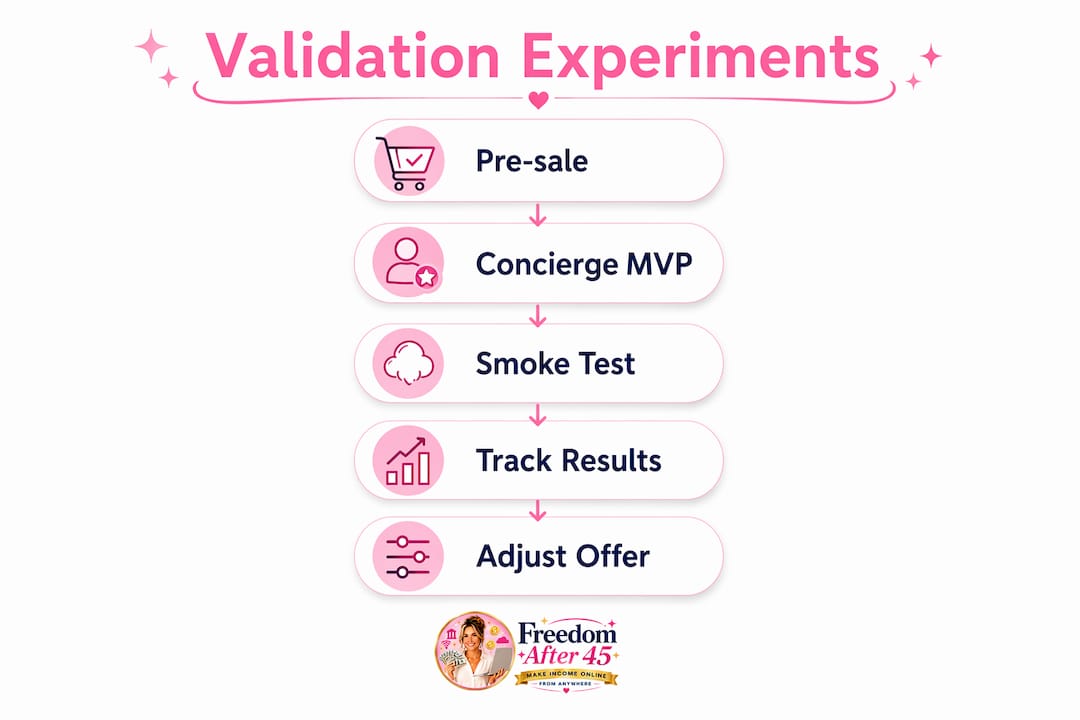
Experiment 1: Pre-sale or deposit campaign
Write a one-paragraph offer describing a specific outcome, a price, and a deadline. Share it directly with five to ten people who have the problem, via text, email, or a community group. Use PayPal, Venmo, Stripe, or Cash App to collect payment immediately. No website required.
Success criterion: Two paid deposits within seven days.
Experiment 2: Concierge MVP (manual delivery)
Deliver the core outcome by hand for two or three paying clients before building any system or product. If you want to sell a meal-planning service, create the plan manually in a Google Doc and charge $30 for it. If you want to sell a resume review, do it over a 30-minute video call and charge $50. Collect payment first, deliver second.

Success criterion: Three paying clients who ask for it again.
Experiment 3: Landing-page smoke test
Build a one-page site on Carrd or Gumroad (free or under $20) with a priced offer and a “Buy Now” button. Run a small paid ad test of $200–$400 on Facebook or Google to drive targeted traffic. Track whether visitors click the pricing button or complete a checkout.
Success criterion: Email capture rate above 15%, or at least one completed purchase.
| Experiment | Estimated Cost | Time to First Signal | Success Threshold |
|---|---|---|---|
| Pre-sale / deposit | $0–$50 | under 48 hours | Two paid deposits within seven days |
| Concierge MVP | $0–$30 | 3–5 days | 3 paying clients |
| Landing-page smoke test | $200–$400 | four to seven days | 15%+ email capture or 1 purchase |
Sample offer phrases you can adapt:
- “I’m offering [specific result] for $[price] this week. Want to be one of the first three?”
- “I’ll do this manually for you by Friday. $[price] via Venmo to hold your spot.”
How the 2-Hour Workflow turns validation into daily income
Two hours a day, focused entirely on revenue-producing tasks, is enough to move from zero to a first paid commitment within a week. Here is how to structure it.
Daily 2-Hour Workflow:
- Minutes 0–20: Review your kill criteria and yesterday’s results. Did anyone pay? Did anyone say no? Log both.
- Minutes 20–50: Direct outreach. Contact five people who fit your target customer profile. Use the behavioral interview questions from Section 2.
- Minutes 50–80: Deliver or prepare delivery for any paying clients. Keep it manual and fast.
- Minutes 80–100: Follow up on anyone who expressed interest but did not pay. Ask the “will you pay now?” question directly.
- Minutes 100–120: Update your metrics log (conversion rate, revenue, outreach count). Adjust tomorrow’s outreach list.
Income math that makes this concrete:
- $25 × 4 sales per day = $100/day
- $50 × 3 sales per day = $150/day
- $100 × 2 sales per day = $200/day
None of those numbers require a social media following, a product launch, or a website. They require five outreach contacts per day and a willingness to ask for money.
“The 2-Hour Workflow gave me a structure I could actually stick to. I made my first $100 in the first week without posting anything on social media.” — Freedom After 45 community member
Document every early win, even small ones. A screenshot of a $25 Venmo payment is a credibility signal you can use in your next outreach message.
How to set the right income objective and track what matters
Choosing among three income objectives before picking tactics prevents wasted effort. Each objective calls for different metrics and different experiments.
The three objectives:
- Stable income floor: You need a reliable minimum each month, no matter what. Focus on repeat clients and recurring offers.
- Specific daily target: You want $100–$200 per day consistently. Focus on conversion rate and average order value.
- Long-term optimization: You want to grow and compound income over time. Focus on repeat rate and referral rate.
For most women starting out, establishing a stable income floor is the right first objective before aiming for higher targets.
| Metric | What It Measures | Early Benchmark |
|---|---|---|
| Conversion rate | % of outreach contacts who pay | Healthy early benchmarks exist but vary by context |
| Revenue per outreach | Total revenue ÷ contacts made | Rising week over week |
| Average order value | Total revenue ÷ number of sales | Aim to increase by 10% monthly |
| Repeat rate | % of clients who buy again | Higher repeat rates typically indicate good product-market fit |
| Kill threshold | Days without a paid commitment | Stop or pivot after seven days with zero |
Exact scripts that move from conversation to payment
Three ready-to-use scripts for different situations:
- Casual community contact (text or DM): “Hey [name], I’m testing a new [service/offer] and looking for three people to try it at a reduced rate. It’s $[price] and I’ll deliver [result] by [date]. Want in? I can take payment via Venmo right now.”
- One-on-one phone or video call: Start with the behavioral questions from Section 2. After they describe the problem, say: “Based on what you just told me, I think I can solve that for you this week. My rate is $[price]. If I can deliver [specific result] by [date], would you be willing to pay now to hold your spot?”
- Follow-up to landing-page interest: “You signed up for more info about [offer]. I have two spots left at the pilot price of $[price]. Here’s a payment link: [link]. It’s good until [date].”
Pro Tip: The most common objection is “I need to think about it.” Respond with: “Totally fair. What would need to be true for you to say yes?” That question either surfaces a real objection you can address or confirms they are not a buyer right now.
Common traps that create real financial risk
Most people who fail at income validation don’t fail because the idea was bad. They fail because they inverted the risk by spending money before proving demand.
Red flags that mean your test is creating real exposure:
- Spending significant amounts before securing your first paid customer
- Quitting or reducing hours at your job before proving income reliability
- Expanding the offer scope because early feedback was “almost interested”
- Counting compliments, shares, or “I’ll definitely buy when it’s ready” as validation
- Continuing testing after reaching defined kill criteria without progress
Safety checklist before each experiment:
- [ ] I have written down my kill criteria (specific number, specific deadline)
- [ ] My total spend for this experiment is capped at $[amount]
- [ ] I have not reduced my primary income to fund this test
- [ ] I know exactly what “success” looks like and what “stop” looks like
- [ ] I have a fallback plan if zero sales occur
If a test fails, preserve cash first. Reframe the offer for a different audience before rebuilding the product. A different customer segment often converts where the first one didn’t.
Key Takeaways
The strongest low-risk income validation is a paid commitment from a stranger, run inside a consistent daily routine with written kill criteria before you spend a dollar.
| Point | Details |
|---|---|
| Money beats interest | A single deposit or pre-order outranks hundreds of email signups as proof of real demand. |
| Write kill criteria first | Set a specific deadline and zero-sales threshold before each experiment to prevent optimism-driven scope creep. |
| Three experiments, low cost | Pre-sale, concierge MVP, and landing-page smoke test each cost under $400 and produce a signal within seven days. |
| Income objectives matter | Pick one objective (floor, target, or optimization) before choosing tactics; each requires different metrics. |
| Freedom After 45 | The 2-Hour Workflow packages these daily routines, scripts, and templates into a structured program for women over 45. |
Why this approach fits women over 45 especially well
The validation methods in this article were built for exactly the constraints most women over 45 are navigating: a job that can’t be abandoned, caregiving responsibilities that eat the margins of the day, and no existing social media audience to leverage.
Two hours is not a compromise. It is a feature. A focused two-hour block, repeated daily, produces more real signal than a scattered 10-hour weekend sprint. The behavioral interview approach requires no platform, no following, and no ad budget. Five direct conversations per day, with a clear ask for money, is a repeatable system anyone can run from a phone.
Small daily revenue streams also compound in ways that feel invisible at first. Hitting $50/day in week one, then $100/day in week three, then $150/day in week six is not a dramatic story. It is a quiet, durable shift in financial independence that does not require anyone’s permission.
The women who see results fastest are not the ones with the best ideas. They are the ones who ask for money on day one, log the result, and adjust on day two.
The 2-Hour Workflow program puts all of this in one place
Pulling together outreach scripts, daily checklists, landing-page copy, and kill-criteria templates on your own takes time most women over 45 don’t have to spare. The Freedom After 45 2-Hour Workflow program packages every element covered in this article into a single, step-by-step system: the daily routine, the behavioral interview scripts, the offer templates, and the income-tracking framework.

Women who follow the program start with the same low-risk validation sprint described here, with no social media following required and no upfront product build. The program is built around the same principle: prove demand with a paid commitment before spending a dollar on anything else. If you want the full system without having to assemble it piece by piece, the daily income blueprint is the practical next step.
This article is general educational information, not financial or legal advice. Confirm any income strategy with a qualified professional for your specific situation.