

Launch a Faceless Side Hustle in 90 Days With AI and 2 Hours a Day
The best faceless side hustle ideas right now are paid newsletters, faceless YouTube or audio channels, printables and print-on-demand, and niche affiliate microsites, because each one lets you build income through a name, brand, or username instead of your face. Pick one format today and publish a small, imperfect version of it within 48 hours. This will not make you rich overnight. It takes real upfront work, but the path is real, and you never have to show your face to walk it.
TL;DR:Most faceless side hustles rely on building a brand or name rather than personal visibility, with quick launch timelines typically between two to twelve weeks.Successful monetization depends on choosing a niche, leveraging AI tools for content creation, and consistently producing steady output over at least three months.Staying anonymous requires careful handling of metadata, dedicated branding channels, and understanding tax, licensing, and legal obligations, which remain the creator’s responsibility.A focused approach—repurposing one research effort into multiple products—maximizes revenue with minimal additional work.Building trust and audience engagement without showing a face takes time, consistency, and transparent communication, especially around quality and value.
Freedom After 45Build Your Side Hustle With StructureFreedom After 45 offers a step-by-step 2-Hour Workflow blueprint for women over 45 seeking recurring income without traditional barriers.Explore Freedom After 45
Table of Contents
- What Are the Best Faceless Business Formats?
- Ten Concrete Faceless Side Hustle Ideas With Step-by-Step Starters
- How Do You Pick One Idea and Land Your First Sale in 90 Days?
- How Do You Stay Faceless and Still Run a Real Operation?
- What Legal and Tax Steps Do Faceless Side Hustles Still Require?
- How Do You Market a Brand When You Can’t Show Your Face?
- What Trips Up Most Faceless Creators, and How Do You Fix It?
- Freedom After 45’s Take on Faceless Work After 45
- Want a Structured Way to Actually Implement This?
- Sources
- FAQ
What Are the Best Faceless Business Formats?
Some faceless formats are built for anonymity from the ground up; others just happen to work well without a personal presence. The six below cover most of what’s actually working for anonymous creators right now, and each pairs differently with AI tools depending on how much content you need to produce.
- Paid newsletters: best for writers who can commit to a weekly schedule; monetized through subscriptions on platforms like Substack or Beehiiv.
- Digital products (templates, guides, planners): best for organized people who like building systems once and selling them repeatedly; monetized through one-off sales on Gumroad or Etsy.
- Faceless YouTube or explainer channels: best for people comfortable narrating over visuals or stock footage; monetized through ad revenue and affiliate links.
- Printables and low-content books: best for anyone who can use Canva or Amazon KDP; monetized through per-unit sales with no inventory.
- Niche affiliate microsites: best for patient researchers willing to write for search engines; monetized through affiliate commissions.
- Paid communities: best for people who enjoy moderating and answering questions; monetized through recurring membership fees.
AI tools shorten the production time on nearly all six, but they pair especially well with newsletters, explainer videos, and affiliate content, where drafting and research eat the most hours.
Ten Concrete Faceless Side Hustle Ideas With Step-by-Step Starters
Here’s where format turns into an actual plan. Each idea below includes what it is, why it works without your face attached, three steps to start, a realistic time-to-first-dollar range, and a starting price point.
1. Paid newsletter. A subscription email built around one specific topic. It works faceless because readers subscribe to the writing, not the writer. Start by picking a narrow niche, publishing five free issues on Beehiiv, then adding a paid tier. First dollar: 4 to 10 weeks. Price: around $7 to $15 a month.
2. Notion or Notability templates. Pre-built productivity systems sold as digital downloads. Buyers care about function, not who made it. Build one template solving a specific problem, list it on Gumroad or Etsy, and share it in relevant subreddits. First dollar: 2 to 6 weeks. Price: typically under $40.
3. Printable planners. PDF planners, trackers, or worksheets. Design in Canva, list on Etsy, and use SEO-friendly titles. First dollar: within several weeks. Price: generally under $20.
4. Amazon KDP low-content books. Journals, log books, and puzzle books require no writing voice at all. Design a cover and interior template, upload through KDP, and order a proof copy. First dollar: within a few months. Price: generally under $20 per copy.
5. AI-generated art bundles. Sellable digital assets like backgrounds, textures, or social templates. Generate a themed set, bundle 20 to 50 assets, and list them on a marketplace. First dollar: within several weeks. Price: typically under $50 per bundle.
6. Faceless YouTube explainer channels. Voiceover narration over stock footage or animations. Script a video around one searchable question, use CC0 licensed footage for B-roll, and publish weekly. First dollar: within a few months. Price: earnings through ad revenue and affiliate commissions.
7. AI-narrated audio stories or podcasts. Fiction or nonfiction narrated by AI or text-to-speech voices. Write or adapt short scripts, generate narration, and distribute on Spotify or Apple Podcasts. First dollar: within a few months. Price: earnings from sponsorships or listener support.
8. Niche affiliate Pinterest microsite. A small content site built around one product category, driven by Pinterest traffic instead of social exposure. Pick a buying-intent niche, publish 15 to 20 posts, and pin consistently. First dollar: within several months. Price: earnings from affiliate commissions.
9. Prompt packs and prompt libraries. Curated AI prompts for writing, image generation, or business tasks. Test and document 50 to 100 working prompts, package them as a PDF or Notion doc, and sell on Gumroad. First dollar: 2 to 5 weeks. Price: $10 to $30.
10. Paid community or Discord. A membership space for people chasing a shared goal. Launch free, prove value for a month, then add a paid tier for deeper access. First dollar: 6 to 10 weeks. Price: generally around $10 to $25 a month.
Pro Tip: Don’t create ten separate content efforts. Turn one deep piece of research into four products: a PDF guide, a newsletter serial, a short audio narration, and a printable summary. One block of work, four revenue channels.
How Do You Pick One Idea and Land Your First Sale in 90 Days?
Run two quick checks before you commit. First, audit your skills and existing assets: can you write, design, narrate, or organize information faster than average? Second, run a demand test: search the topic on Google, check Pinterest trends, and skim relevant subreddits to see if people are already asking for what you’d sell.
Once you’ve picked a lane, work the calendar in blocks. A practical launch cadence looks like this:
- Weeks 1 to 2: build a rough prototype and get five people to react to it.
- Weeks 3 to 4: finish the real version and publish it publicly.
- Weeks 5 to 8: drive traffic through SEO, Pinterest, or targeted forums.
- Weeks 9 to 12: make your first sale and adjust pricing or messaging based on what sold.
Minimum tech needs are small: a storefront (Gumroad or Etsy), a hosting or newsletter provider (Beehiiv, Substack, or a simple website), and a way to track visitors. Track conversion rate and cost to acquire your first customer early. Ramsey Solutions notes that legitimate passive income takes real upfront work before it becomes hands-off, so treat these 90 days as building, not coasting.
How Do You Stay Faceless and Still Run a Real Operation?
Staying anonymous is mostly a matter of habits, not secrecy tricks. Pick a brand name or pseudonym and use it consistently across every account and file. Set up a separate email address and, once money starts moving, a separate bank account. Some faceless creators eventually form an LLC to keep business and personal finances cleanly split.
- Strip metadata from every image, PDF, and video file before uploading.
- Use dedicated brand social accounts, never a personal profile, for any promotion.
- Avoid personal names, locations, or identifiers in filenames and folder structures.
- Choose platforms like Gumroad, Etsy, Substack, or Lemon Squeezy that explicitly support brand and pseudonym sellers.
- Keep basic bookkeeping from day one so tax season doesn’t become a scramble.
Pro Tip: Before publishing anything, download the file yourself and check its properties for embedded location data or your real name in the metadata. A five-minute EXIF check now saves you from an identity leak later.
What Legal and Tax Steps Do Faceless Side Hustles Still Require?
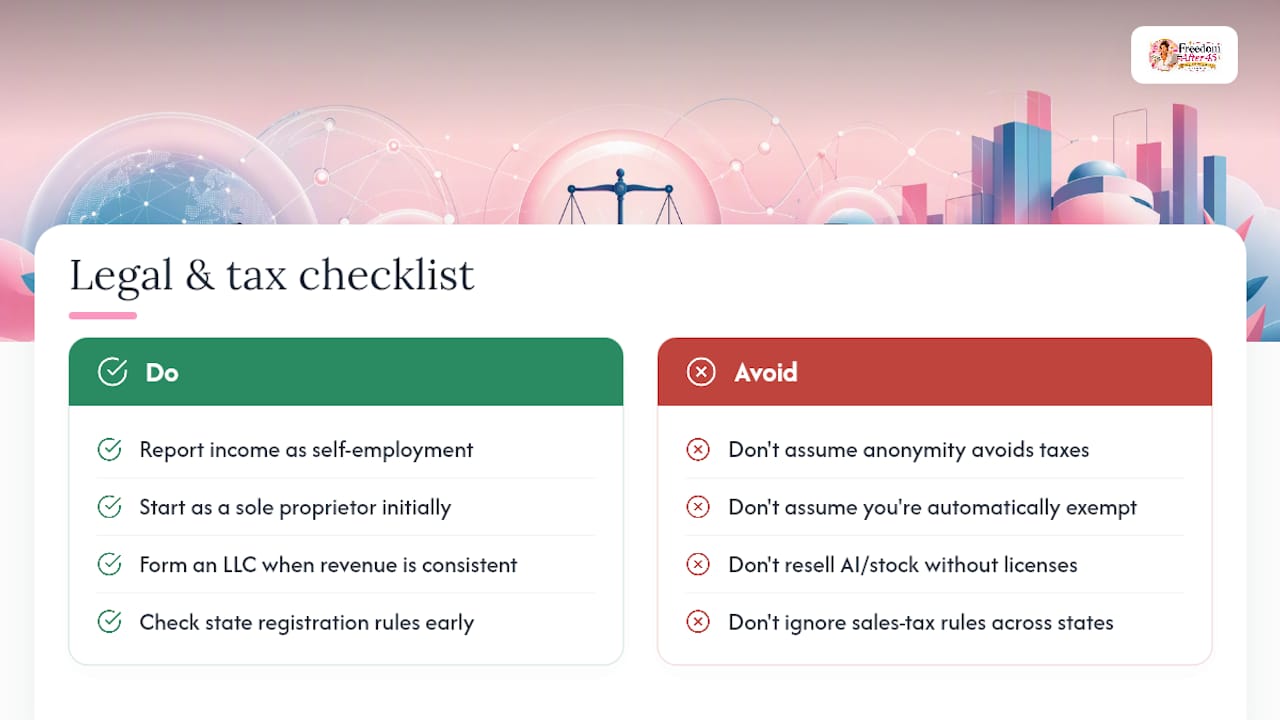
Anonymity protects your public identity, not your legal obligations. Whatever name appears on your storefront, the income still belongs to a real person or entity for tax purposes, and the IRS expects it reported the same way any other self-employment income would be. Most solo faceless sellers start as a sole proprietor, then consider forming an LLC once revenue becomes consistent, mainly to separate personal and business liability rather than to hide ownership.
Business registration requirements vary by state and by how much you earn, so check your state’s specific rules before assuming you’re exempt. Selling digital products across state lines can also trigger sales tax obligations depending on where your buyers live, which is worth understanding early rather than after a few hundred sales.
Digital rights matter just as much as tax status. If you use AI-generated art, narration, or text in a product you sell, read the terms of the tool you used. Some AI platforms retain certain rights or restrict commercial resale. Stock footage and music need proper licensing too. CC0-licensed assets carry no attribution requirement, which makes them a safer default for faceless creators who don’t want a licensing dispute tracing back to a real name. None of this requires a lawyer on day one, but a folder of saved license terms and receipts will save you real trouble if a platform ever asks for proof.
How Do You Market a Brand When You Can’t Show Your Face?
Faceless marketing leans harder on search and content than personality-driven platforms do, and that’s actually an advantage if you’re consistent. SEO carries more weight for faceless brands than for personal brands, because a well-optimized blog post, video description, or Pinterest pin keeps working long after you’ve walked away from the screen. Write around specific, searchable questions your buyer is already typing into Google, not generic topics.
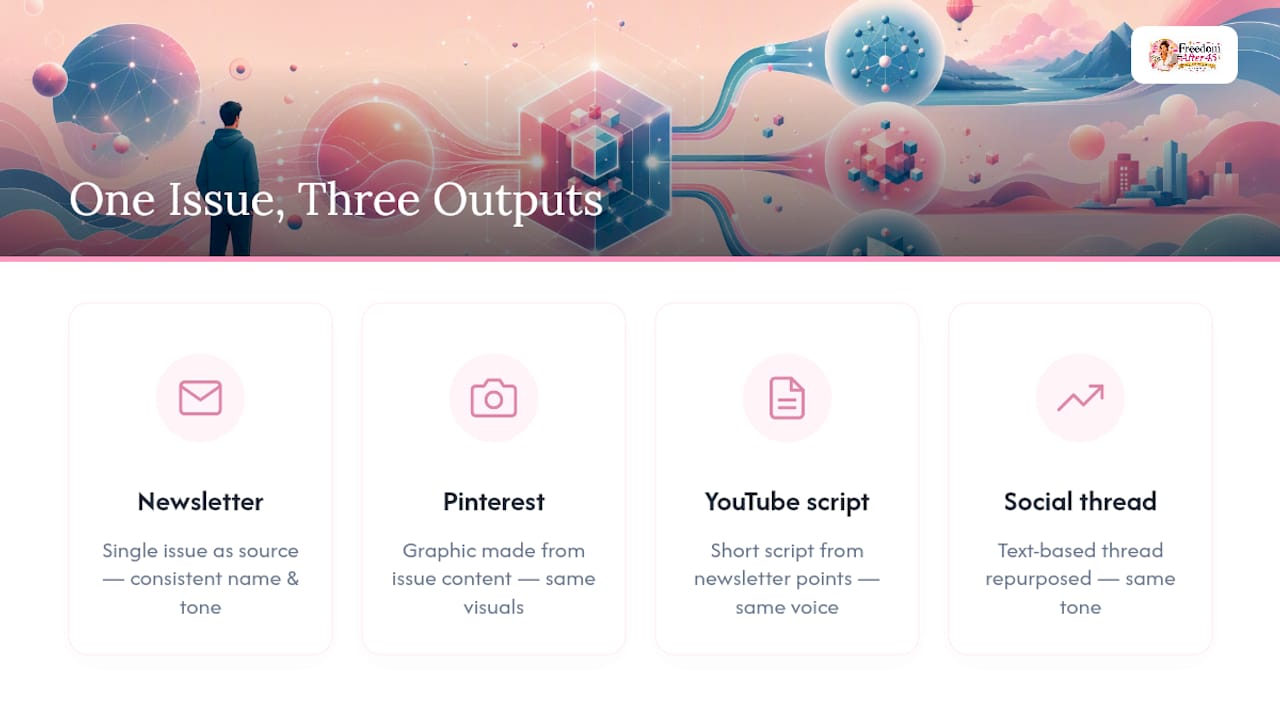
Content distribution matters more than any single platform. A single newsletter issue can become a Pinterest graphic, a short YouTube script, and a Twitter/X thread, tripling its reach without tripling your workload. Faceless brands that survive tend to treat their name, visual style, and tone of voice as the actual product feature replacing a personal identity, keeping it consistent enough that returning readers recognize the brand instantly even without ever seeing a person behind it.
Social media still works without personal exposure. Brand accounts, consistent graphics, and a recognizable voice do the job a face usually does. Skip anything that requires video of yourself if staying anonymous is the priority, and lean into formats like carousel posts, voiceover reels, or text-based threads instead.
What Trips Up Most Faceless Creators, and How Do You Fix It?
Trust is the real obstacle, not traffic. Buyers hesitate to pay a stranger with no face and no track record, so faceless brands have to earn trust through other signals: testimonials, transparent refund policies, consistent publishing, and clear “about” pages that explain the mission even without a headshot.
Audience engagement is the second challenge. It’s harder to build loyalty around a brand name than around a person people feel they know. The fix is consistency of voice, not personality. Reply to every comment and email in the same tone every time, so the brand itself starts to feel familiar. Many successful anonymous newsletters and stores hit a milestone of 500 to 1,000 engaged readers before introducing a paid tier, using that early audience as proof the brand delivers value before asking anyone to pay.
The other common trap is switching ideas too fast. Most faceless formats need eight to twelve weeks of steady output before results show up at all. Give one idea a full quarter before deciding it doesn’t work.
Freedom After 45’s Take on Faceless Work After 45
This kind of time-boxed, repeatable task maps well onto faceless formats. You don’t need a following, a product, or your face on camera. Anonymity and steady income aren’t opposites. For women over 45 rethinking what income looks like, this combination is worth taking seriously.
— Freedom After 45
Want a Structured Way to Actually Implement This?
Everything above works, but picking a format and building it alone, without a system, is where most people stall out around week three. Freedom After 45 built the 2-Hour Workflow specifically for that gap: a structured, low-exposure system designed for women over 45 who want a clear daily process instead of ten scattered ideas competing for attention.

The program walks you through choosing one workflow, setting it up with templates, and following a step-by-step blueprint instead of guessing your way through trial and error. It includes video instruction and access to a community of people building the same kind of low-exposure income, so you’re not troubleshooting alone at 9 p.m. wondering if you picked the wrong niche. It’s built for structure-seekers, not for anyone hoping to skip the work entirely. If a guided daily system sounds more workable than piecing this together solo, you can explore the 2-Hour Workflow and see whether it fits how you want to spend your two hours a day.
Sources
- Passive income streams to build in 2026 - Ramsey Solutions
- The Rise of Anonymous Income Streams: How Creators Monetize Without Showing Their Face - Beatmagazines
FAQ
What are some profitable faceless business ideas?
Paid newsletters, printables, low-content KDP books, prompt packs, and niche affiliate microsites are among the most accessible faceless formats, since each monetizes through a brand name rather than a personal identity.
How can I make an extra $2,000 a month without a job?
Layering two or three faceless income streams, such as a digital product store paired with an affiliate microsite, is a more realistic path than relying on one format alone, though it typically takes several months of consistent work to reach that level.
What is the most profitable side hustle?
There’s no single “most profitable” faceless side hustle. Paid newsletters and digital products tend to have the best margins because they carry no inventory and scale with almost no added cost per sale.
How can I make $1,000 a week from a side hustle?
That level usually requires a paid tier with several hundred subscribers, a digital product with steady traffic, or multiple smaller income streams running at once. It’s an achievable milestone, not a starting point.
Is Freedom After 45’s 2-Hour Workflow good for starting a faceless side hustle?
Yes. It’s designed as a structured, step-by-step system for building income in short daily sessions, which fits naturally with faceless formats that don’t require an existing audience or on-camera presence.