

Daily Payout Side Hustles: A 2-Hour Blueprint for Women 45+
The 2-Hour Workflow can produce recurring daily payouts, but only when you follow it consistently for weeks, not days. The program frames realistic earnings within a wide daily range once the system is running, though most women see their first small payouts within a few weeks and steadier, dependable income closer to the three-month mark.
Two things back that claim up. First, the Earning Daily program reports it has already helped thousands of families build this kind of income using the same repeatable structure. Second, learning-design research on older adults shows that short, structured, low-overwhelm lessons, exactly the format this workflow uses, improve retention and follow-through for exactly this age group.
- Verdict: Yes, achievable with consistent 2-hour daily sessions
- Earnings band: $100 to $1,400 per day, scaling over time
- Timeline: first payouts in weeks, steady daily income in months
Key Takeaways
The 2-Hour Workflow succeeds when women 45 to 65 pair a small evergreen digital offer with a minimal tool stack and consistent two-hour daily sessions over a realistic 90-day timeline.
| Point | Details |
|---|---|
| Earnings band and timeline | Expect $100 to $1,400 daily once running, with first payouts in weeks and steady income in months. |
| Five-tool stack is enough | An AI writing assistant, Canva, a document tool, a payment processor, and email cover the whole system. |
| Follow the 90-day phases | Build in weeks 1 to 4, launch to first buyers in weeks 5 to 8, then automate and scale in weeks 9 to 12. |
| Community speeds results | Templates and feedback loops shorten the learning curve more than solo trial and error. |
| Freedom After 45’s course | The 2-Hour Workflow course packages this exact system into video modules, templates, and community support. |
Table of Contents
- What Daily Payout Side Hustles Actually Require
- Who This Method Actually Fits
- Your 90-Day Starter Plan In Two-Hour Blocks
- Common Mistakes That Slow Your First Payout
- What Does This Actually Cost To Run?
- Scaling From First Payouts To Steady Income
- Legal and Tax Basics You Shouldn’t Skip
- Passive Versus Active: What You’re Really Building
- Getting Support Without Getting Stuck
- Why Most Advice On This Topic Misses the Point
- Inside the 2-Hour Workflow Course
- Sources
What Daily Payout Side Hustles Actually Require
A daily payout side hustle in this sense isn’t a gig app or a survey site. It’s a small digital asset, built once, that keeps generating sales with minimal daily upkeep. The 2-Hour Workflow runs on one core loop: build a small evergreen offer, connect it to a minimal sales path, and then automate the parts that don’t need your daily attention.
Here’s how that loop plays out in practice:
- Create the asset. A checklist, template, or short workbook that solves one specific problem for one specific person.
- Build the path. A single landing page or simple storefront where someone can pay and receive the product instantly.
- Automate the handoff. Email delivery, payment confirmation, and follow-up messages run without you touching them daily.
You don’t need a warehouse of software to do this. Most successful midlife creators lean on the same small stack: an AI writing assistant to organize and structure your knowledge, Canva for lightweight graphics, a simple document or PDF tool for the finished deliverable, a payment processor like Gumroad or PayPal, and one email tool for follow-up messages. That’s five tools, not fifteen.
- AI writing assistant (structures your knowledge into a sellable format)
- Canva or a similar simple design editor
- A basic payment and sales landing tool (Gumroad, PayPal, or Stan Store)
- An email or messaging workflow for delivery and follow-up
- A basic analytics view so you know which offer is actually selling
The pacing matters as much as the tools. Research on remote digital skills training for older women found that shorter, more frequent sessions with personalized support built digital confidence faster than long, dense tutorials. That’s precisely why the 2-Hour Workflow breaks everything into daily blocks instead of one overwhelming weekend crash course.
Pro Tip: *Treat your first offer as a rough draft, not a masterpiece.
Who This Method Actually Fits
This isn’t for everyone, and it shouldn’t be. It fits women roughly 45 to 65 who can commit about two hours a day, who don’t need to master new technology overnight, and who are willing to sell something small before it feels “ready.”
Expect a conservative timeline: small first payouts within the first few weeks, and steadier daily income building over two to three months of consistent effort. That’s slower than viral success stories promise, but it’s realistic.
Watch for these signals that you’re not ready yet:
- You can’t commit two consistent hours most days for at least 90 days
- You’re looking for a guaranteed income figure rather than a repeatable system
- You expect results without ever publishing or selling anything imperfect
- You have no tolerance for learning one new simple tool at a time
Your 90-Day Starter Plan In Two-Hour Blocks
You don’t need a complicated roadmap. You need three phases, each about four weeks long, with a clear task for each daily session.
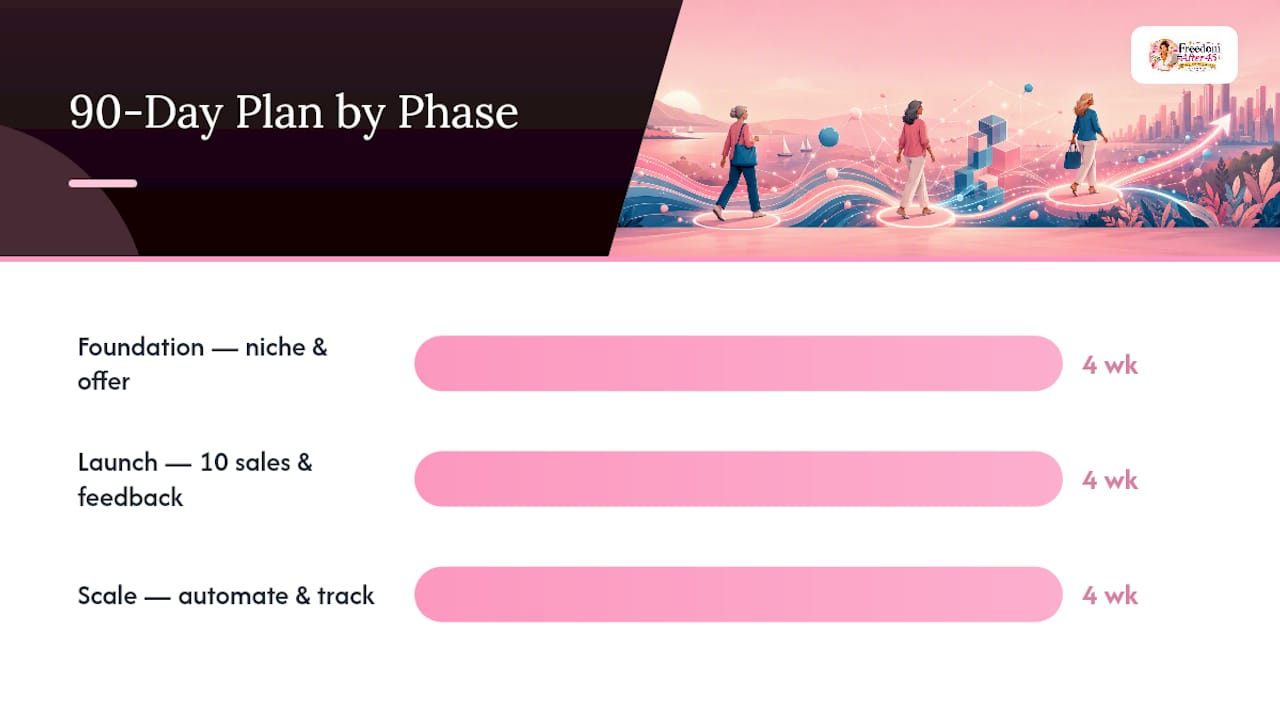
Weeks 1 to 4: Foundation. Pick one narrow niche where you already have real knowledge, whether that’s meal planning for diabetics, decluttering a small home, or organizing a first-year retirement budget. Create your first small offer, a checklist or short guide, and set up a basic payment link.

Weeks 5 to 8: Launch the MVP. Sell to your first 10 customers, even if that means personally messaging people in your network or a relevant online group. Collect feedback on what confused them or what they wished the offer included, then refine it.
Weeks 9 to 12: Optimize and scale. Automate the outreach messages you’ve been sending manually, repackage your offer based on feedback, and start tracking which days and channels produce your daily payouts.
A sample two-hour session might look like: 20 minutes reviewing yesterday’s sales and messages, 60 minutes creating or refining content, 20 minutes on outreach or posting, and 20 minutes on simple analytics or email follow-up.
- Choose your niche and draft your first offer (Week 1)
- Set up your payment link and delivery method (Week 2)
- Soft-launch to your warmest contacts (Week 3)
- Sell your first units and log feedback (Weeks 4 to 6)
- Refine the offer based on what buyers actually said (Week 7)
- Automate outreach and repeat the sales loop daily (Weeks 8 to 12)
| Phase | Focus | Weeks |
|---|---|---|
| Foundation | Niche, first offer, payment setup | 1 to 4 |
| Launch | First 10 sales, feedback collection | 5 to 8 |
| Scale | Automation, repackaging, tracking | 9 to 12 |
Common Mistakes That Slow Your First Payout
Most delays come from a handful of avoidable habits, not from the method itself.
- Perfectionism before launch. Fix this by giving yourself a hard deadline to sell, even if the offer feels 80% done.
- Paralysis by analysis. Fix this by choosing the first reasonable niche idea instead of comparing ten options for weeks.
- Building before validating. Fix this by messaging five potential buyers before you finish the product, not after.
- Ignoring early feedback. Fix this by treating your first 10 customers as your unpaid consulting team.
Three quick wins speed things up. First, launch a simple digital product like a one-page checklist rather than a full course. Second, use a direct outreach script, something as plain as “I built this to solve X, want early access for $9?”, sent to five people you already know. Third, run small-batch launches of 5 to 10 units before scaling wider, so mistakes stay cheap.
Pro Tip: Launch imperfectly, then let your first buyers tell you what to fix. Waiting for a flawless offer costs you more in delayed income than any early mistake ever will.
What Does This Actually Cost To Run?
Beyond the core five-tool stack, expect modest recurring costs, not a big upfront investment. Most simple payment processors like Gumroad or PayPal charge a small percentage per sale rather than a flat monthly fee, so your early costs stay tied to actual revenue. Design tools like Canva typically run a low monthly subscription if you go beyond the free tier, and basic email tools often start free before scaling with your list size.
Marketing costs are optional at first. Your initial 10 sales can come from direct outreach and warm contacts, which costs nothing but time. As you scale, you might add a small paid promotion budget or a simple lead magnet, but this should stay proportional to what you’re already earning, not a bet made before you have any sales at all.
Recurring costs to budget for once you’re established include your payment processor’s percentage fees, a design tool subscription, an email platform once your list grows past its free tier, and possibly a small monthly cost for any community or template access you use. None of these need to add up to more than a modest monthly amount, especially compared to traditional business overhead like inventory, rent, or staff.
Scaling From First Payouts To Steady Income
Your first daily payout proves the system works. Turning that into sustainable income means repeating the loop, not reinventing it.
Once your first offer sells consistently, look for ways to repackage the same knowledge into a second related offer, a bundle, or a slightly higher-tier version. Customers who bought your $9 checklist are often your best prospects for a $47 deeper guide. This is far more efficient than constantly chasing brand-new audiences.
Automation does the heavy lifting at this stage. Email sequences that deliver your product and follow up with a next offer, combined with a simple tracking view of which days and sources bring in sales, let you spend your two hours on refining and creating rather than repetitive manual tasks. Practitioner data on midlife entrepreneurs suggests many reach modest recurring income in the $500 to $2,000 monthly range within four to nine months, with service-based offers often reaching that point faster than pure content plays.
Legal and Tax Basics You Shouldn’t Skip
Selling a digital product, even a small one, makes you a business owner in the eyes of the tax authority. Income from your checklist, guide, or workbook counts as self-employment income and needs to be reported, typically on a Schedule C if you’re operating as a sole proprietor in the United States.
Keep simple records from day one: what you earned, what you spent on tools and any marketing, and the dates of each sale. Many women in this stage benefit from setting aside a percentage of each payout for quarterly estimated taxes rather than getting hit with one large bill later. A basic spreadsheet or a simple bookkeeping app handles this fine at this scale; you don’t need complex accounting software for a five-tool operation.
Depending on your state and how you structure your sales, you may also need to consider sales tax on digital products, which varies significantly by location. This is a case where checking with a tax professional familiar with digital product sales in your state saves more money than it costs, especially once your daily payouts become consistent enough to matter on a tax return.
Passive Versus Active: What You’re Really Building
The word “passive” gets overused in this space, so let’s be precise about what’s actually passive here and what still requires your attention.
The active component is real: creating your first offer, writing outreach messages, responding to buyer questions, and refining based on feedback all take deliberate effort, especially in the first 90 days. This is where your two daily hours actually go.
The passive component kicks in after the asset exists. Once your checklist or guide is built and your payment link is live, each individual sale doesn’t require you to personally do anything. The system delivers the product, processes payment, and sends a follow-up email automatically. Your daily payout comes from a library of past effort compounding, not from new work matching each new sale. That’s the real distinction: you’re trading a burst of upfront active work for a smaller, ongoing active maintenance role, in exchange for payouts that don’t require matching hours to income.
Getting Support Without Getting Stuck
Nobody builds this alone well, and you shouldn’t try to. Community access, reusable templates, and a simple feedback loop cut your learning curve dramatically compared to figuring everything out solo.
Templates matter more than most guides admit. Instead of designing your landing page or outreach message from scratch, starting from a proven template lets you focus your two hours on the parts that actually need your judgment, like your specific niche knowledge and voice. A 2026 study on older adults and digital engagement found that digital literacy strongly predicts online engagement, and that integrating structured support with simple tools measurably increases both confidence and follow-through.
A feedback loop doesn’t need to be complicated. Posting your draft offer in a small community group, asking three specific questions, and adjusting based on real answers beats weeks of solo second-guessing. This mirrors what researchers found when studying personalized digital training for older women: one-to-one or small-group support with short, frequent check-ins built confidence faster than isolated self-study ever did. If you’re building a daily payout side hustle solo with no one to ask “does this make sense,” you’re making the hardest version of this path.
Why Most Advice On This Topic Misses the Point
Most content about earning money online for women over 45 either oversells virality or undersells the learning curve. Neither is honest. The actual bottleneck isn’t motivation or intelligence, it’s cognitive load. A woman with three decades of hard-won expertise doesn’t fail at this because she can’t learn a payment tool. She fails when she’s handed ten tools, a vague timeline, and no feedback loop, all at once.
What the research on older learners actually supports is narrower and more useful: short sessions, one clear task per block, and quick access to real feedback beat comprehensive courses every time. That’s an argument for slower, structured pacing, not less ambition.
If you’re evaluating this path, prioritize the plan’s structure and support system before you evaluate the earnings numbers. A realistic 90-day timeline with community feedback will outperform a vague promise of fast money with none.
— Freedom After 45
Inside the 2-Hour Workflow Course
Freedom After 45 built the 2-Hour Workflow specifically around everything covered above: short daily sessions, a minimal five-tool stack, and a step-by-step MVP launch plan instead of a vague promise to “start a business.”
The course includes structured video modules broken into short, cognitive-load-friendly lessons, a downloadable workflow blueprint you can follow block by block, reusable templates for your offer, landing page, and outreach messages, and access to a community for feedback and accountability. The program states it has already helped thousands of families build recurring daily income using this exact structure, with real case studies and testimonials shared inside the course itself.
If the 90-day plan above made sense to you but you’d rather follow a done-for-you blueprint than build your own from scratch, the 2-Hour Workflow course walks you through every phase with templates already built. Visit the program page to see the full curriculum and enroll when you’re ready to start your first 90-day cycle.
Sources
- Education 5.0: Requirements, Enabling Technologies, and Future Directions
- Frontiers in Psychology (WW.it digital intervention study)