
Content Without Social Media: A 2-Hour System for Women 45+
You can build and sell digital content without posting a single reel, story, or status update. A repeatable 2-hour-per-day system built around email, search, and evergreen sales pages does the work that a social following used to do, and it does it without an algorithm deciding whether anyone sees you. Email marketing alone converts roughly 40 times better than social referrals for many course creators, and that single fact changes how you should spend your two hours.
Three things to do this week, in order:
- Build one lead magnet that solves a single, specific problem for your ideal customer.
- Set up a one-page opt-in funnel that trades that lead magnet for an email address.
- Block two uninterrupted hours a day, same time daily, for the next seven days, and protect that block like an appointment.
Key Takeaways
A repeatable 2-hour daily system built on email, search, and evergreen funnels replaces social media as the engine for selling digital content.
| Point | Details |
|---|---|
| Pick one product first | Choose a mini-course or template based on shortest time-to-MVP, not the biggest idea. |
| Follow the 8-week plan | Validate with real conversations before building anything, then launch a small paid pilot. |
| Protect your daily block | Batch similar tasks into two 2-hour sessions and match energy level to task type. |
| Track five core numbers | Watch list growth, open rate, click rate, landing page conversion, and sales conversion. |
| Use a ready-made system | Freedom After 45’s 2-Hour Workflow blueprint provides this exact structure with community support. |
Table of Contents
- What Kind of Content Sells Without Social Media
- Your 8-Week Build-and-Launch Plan
- Your Daily 2-Hour Workflow
- The Tools You Actually Need to Launch
- What $100 to $1,400 a Day Actually Looks Like
- Tracking What Matters and Fixing What Doesn’t
- Serving Customers Without a Social Feed
- Staying Compliant When You Sell Outside Social Platforms
- Designing a Funnel That Converts While You Sleep
- Why This System Fits Women Building a Second Act
- A Ready-Made Path if You’d Rather Skip the Guesswork
- Sources
What Kind of Content Sells Without Social Media
Not every digital product fits an email-and-search strategy equally well. Some are fast to build and cheap to sell; others take longer but earn more per customer. Picking the right one first saves you weeks.
A mini-course teaching one transformation (not a whole topic) tends to be the fastest path to a first sale. Templates and workbooks come next. Ebooks and guides are easy to write but harder to price above $27–$47 unless you bundle them. Evergreen webinars and workshops convert well because a single live or recorded session compresses trust-building that would otherwise take weeks of content. Memberships and micro-subscriptions build recurring revenue but need more upfront structure.
| Product Type | Best Channel | Time to First Version |
|---|---|---|
| Mini-course | Email + evergreen sales page | 1–2 weeks |
| Template or workbook | SEO blog post + email | Days |
| Ebook or guide | Marketplace listing + email | 1 week |
| Evergreen webinar | Email sequence + landing page | 2 weeks |
| Membership | Email + affiliate partners | 3–4 weeks |
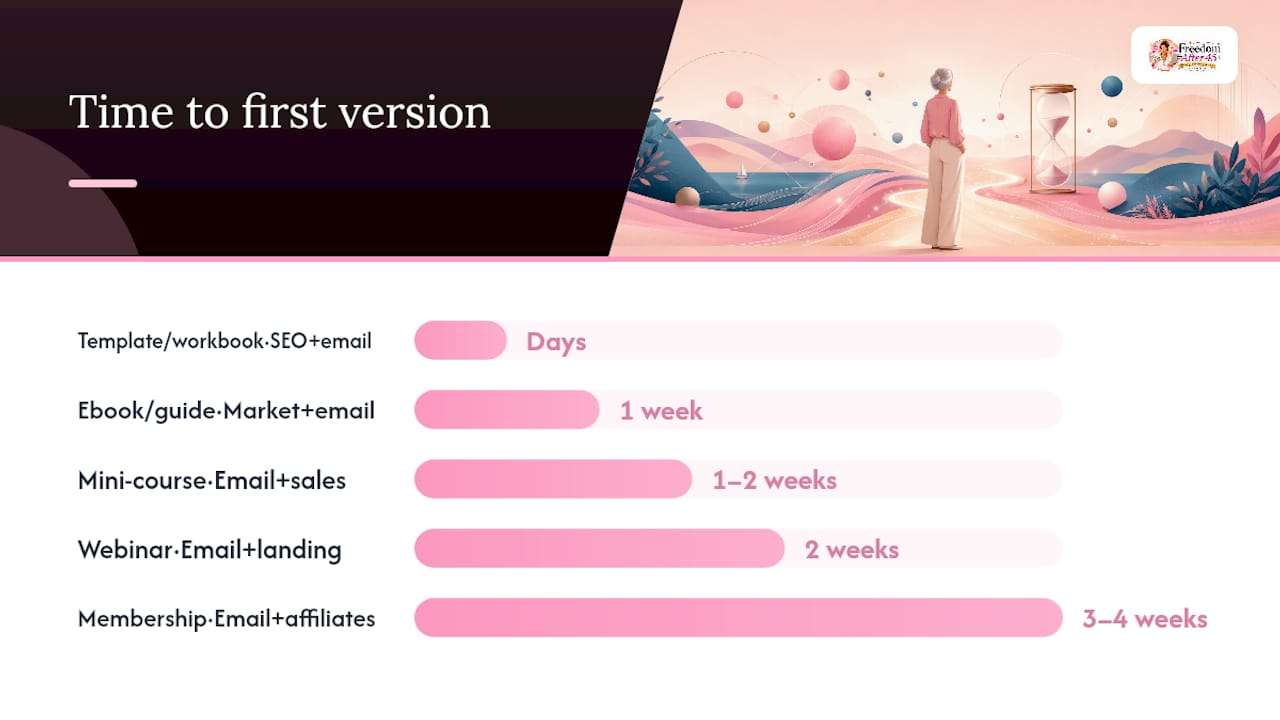
Pick the one with the shortest build time relative to your price point. If you’re new to this, start with the mini-course or the template. Both give you a testable offer inside two weeks.
Your 8-Week Build-and-Launch Plan
Eight weeks, two hours a day, five days a week, gets you from idea to a paying pilot group. This is not a theoretical timeline. It mirrors the validation-to-launch structure used by course creators launching with no existing audience.
Weeks 1 and 2: Validate before you build.
- Talk to 10 to 15 people in your target market. Ask what they’re struggling with, not what they’d buy.
- Draft one lead magnet that answers the single most repeated problem from those conversations.
- Sketch the outline of your mini-course or template based on what you heard, not what you assume.
Weeks 3 and 4: Build the funnel.
- Set up a simple landing page that offers the lead magnet.
- Connect it to an email provider with a short automated welcome sequence.
- Run one free workshop or training session and collect signups through that same page.
Weeks 5 and 6: Test with real buyers.
- Send a short pre-launch email sequence to your growing list, teasing the paid offer.
- Open a paid pilot to your first 5 to 10 students, priced 40 to 60 percent below what you’ll eventually charge.
- Deliver the pilot personally and take detailed notes on where people get stuck.
Weeks 7 and 8: Open the evergreen funnel.
- Raise the price to your real number and open the offer permanently.
- Add basic tracking so you know which page, email, or source drives sales.
- Recruit one or two partners or affiliates to promote the finished product.
- Write down your launch checklist so the next product takes half the time.
By week 8 you should have a functioning, low-maintenance sales sequence: lead magnet, welcome emails, sales page, and delivery. That’s your MVP, and it should not need daily social posting to keep converting.
Pro Tip: Price your pilot lower than you think you should. A $47 pilot that gets 8 people talking and giving feedback is worth more than a $197 offer that gets zero buyers because nobody trusts you yet.
Your Daily 2-Hour Workflow
The eight-week plan only works if your daily two hours are structured, not scattered. Batching similar tasks into the same session keeps you from losing 20 minutes every day just switching mental gears.
A sample week looks like this:
- Monday: Writing and SEO. Draft or edit one blog post or product description.
- Tuesday: Lead magnet creation. Build or refine the free resource that fuels your funnel.
- Wednesday: Email sequence work. Write or adjust two to three emails in your welcome series.
- Thursday: Outreach. Message five potential customers, partners, or past contacts directly.
- Friday: Repurposing and analytics. Turn one blog post into a Pinterest pin description; check your numbers.
Split each 2-hour block into two 50 to 55-minute sessions with a short break between them. Do your highest-energy creative work (writing, course content) in the first session, and lower-energy tasks (formatting, scheduling, replying to emails) in the second.
- Keep a running checklist so you never open your laptop wondering what to do first.
- Close every other browser tab before you start; a 2-hour block interrupted by email notifications is a 45-minute block in disguise.
- Batch a full week of email content in one Wednesday session rather than writing one email a day.
Pro Tip: If you only have low energy on a given day, do the analytics review or the outreach messages instead of trying to force creative writing. Match the task to your energy, not the calendar.
The Tools You Actually Need to Launch
You do not need a complicated stack. Five categories cover everything: an email provider with automation, a simple landing page tool, a way to deliver your product (downloads or a course platform with a paywall), a payment processor, and basic analytics.
Connect them in this order: lead magnet delivery links to your email provider, which triggers your welcome sequence, which points to your sales page, which hands off to your payment processor for delivery. Most beginner-tier plans on these tools handle a list under 1,000 subscribers for $20 to $40 a month combined.
- Choose an email provider with pre-built automation templates so you’re not coding sequences from scratch.
- Use a landing page builder with drag-and-drop editing rather than a full custom website for your first offer.
- Add a marketplace listing (a storefront platform built for digital downloads) as a secondary channel once your own funnel is working, not before.
Configure everything once, test the full path yourself as a customer would, then leave it alone. The point of an evergreen system is that you stop rebuilding it every week.
What $100 to $1,400 a Day Actually Looks Like
The math behind these numbers is simpler than it sounds once you separate list size from price point. Small, highly engaged lists of 2,000 to 5,000 subscribers can generate a few thousand dollars a month by stacking a low-cost tripwire offer with a higher-priced core product.

| Daily Target | Sample Offer | Buyers Needed Daily |
|---|---|---|
| $100 | $27 template | 4 |
| — | mini-course | 5–6 |
| $1,400 | $197 course + $27 tripwire | 6–8 combined |
Use conservative assumptions: a 20 to 30 percent email open rate, a 2 to 5 percent landing page conversion rate, and a modest daily lead flow. Build your 90-day projection around your slowest realistic month, not your best one.
Tracking What Matters and Fixing What Doesn’t
Watch five numbers: list growth, open rate, click rate, landing page conversion, and email-to-sale conversion. If sales are flat, fix the lead magnet’s conversion rate first, then the email sequence, then the sales page copy, in that order.
- Test one headline change per week, not five at once.
- Track lead source so you know whether SEO, Pinterest, or outreach is doing the heavy lifting.
Pro Tip: A single subject line swap on your welcome email can move open rates more than a full week of new content. Test that before you rewrite anything else.
Serving Customers Without a Social Feed
Loyalty without social media comes from responsiveness, not visibility. When a customer emails a question, a same-day reply matters more than any post you could have made that day. Set up a simple support email address, check it twice daily during your workflow blocks, and use canned responses for the five questions you’ll get repeatedly.
Community doesn’t require Facebook Groups or Discord servers. A private email list segment for paying customers, a monthly check-in email, or a simple shared document where students post wins does the same job. Some creators run a single live Q&A call per month for active students. It costs one hour and builds more trust than weeks of public posting.
Ask for feedback directly through email surveys after purchase. This does double duty: it surfaces problems before they become refund requests, and it gives you language for future marketing that comes straight from real customers. Repeat buyers usually come from feeling heard once, not from being marketed to twice. Treat every support email as a chance to earn a second sale later, not just a task to close out.
Staying Compliant When You Sell Outside Social Platforms
Selling on your own site and through email carries different obligations than selling through a social platform’s built-in shop. You’re responsible for your own payment processing security, your own refund policy, and clear terms of sale on every product page.
Check the specific requirements of whichever payment processor and course or download platform you use. Most reputable ones handle PCI compliance and tax collection automatically, but you still need a visible refund policy, clear licensing terms if you sell templates others might resell, and an accurate privacy policy if you collect email addresses. Email marketing itself is regulated. Include a working unsubscribe link in every message and only email people who opted in.
If you sell courses that make health, financial, or legal claims, be precise about what your product does and doesn’t promise. Overpromising results invites refund disputes and, in some categories, regulatory attention. Keep records of your pilot cohort’s actual outcomes rather than projecting numbers you haven’t verified. Digital delivery also means you need a reliable backup of your files. A single Dropbox link that breaks costs you sales and support headaches you could have avoided with a proper delivery platform.
Designing a Funnel That Converts While You Sleep
An evergreen funnel only works if the first five minutes of a stranger’s experience make sense without you standing there to explain it. Your opt-in page needs one clear promise, one clear action, and nothing else competing for attention.
Once someone joins your list, the welcome sequence does the trust-building work a social feed would normally do over months of posts. A four to seven-email sequence spread over one to two weeks, each message solving a small piece of the reader’s problem, works better than one long sales pitch. Segment your list early. A lead magnet built around one narrow problem lets subscribers self-identify, so someone who downloaded a “get organized” checklist gets different follow-up emails than someone who downloaded a “start earning” guide.
Your sales page itself should answer three questions in order: what is this, who is it for, and what happens after I buy. Skip long testimonials sections if you don’t have real ones yet. A simple, honest description of the transformation the pilot group experienced does more work than filler copy. Test the entire path yourself, from opt-in to delivery, before sending a single stranger through it.
Why This System Fits Women Building a Second Act
Two focused hours beat eight scattered ones, especially when you’re managing a career, family, or health on the side. Owned channels like email don’t punish you for taking a week off the way social algorithms do.
Decades of work experience mean faster validation. You likely already know your first ten customers by name, whether through a former career, a community group, or a professional network. That’s a shortcut most 25-year-old creators don’t have. If you’d rather follow a built system than design one from scratch, the 2-Hour Workflow blueprint lays out this exact structure step by step.
A Ready-Made Path if You’d Rather Skip the Guesswork
Everything in this guide, the 8-week plan, the daily 2-hour structure, the funnel setup, is exactly what Freedom After 45’s 2-Hour Workflow blueprint walks you through, already built and tested. Instead of piecing together advice from five different sources, you get one step-by-step program with video instructions, real case studies, and access to a community of women working through the same system.

It’s built for women over 45 who want daily income between $100 and $1,400 without needing a following, a product idea, or years of trial and error to get there. Thousands of families have already used it to move from “someday” to a working evergreen funnel with paying customers. If you want the shortest path from where you are now to your first paying student, start the 2-Hour Workflow today and follow the blueprint week by week.
Sources
- Sell Courses Without Social Media - 7 Methods | Teachery
- How to Market Courses Without Social Media in 9 Easy Steps
- Newsletter Monetization 2026: 7 Ways to Earn $2K–$10K
- How to Launch an Online Course with No Audience (2026 Guide)