

Build Recurring Income in 2 Hours a Day After 45
You build recurring income by picking one repeatable offer, selling it on a simple platform, and protecting two focused hours a day to run it. Most women following the Freedom After 45 2-Hour Workflow see their first sale inside 30 days, with steadier monthly income forming by month three.
Do this in your next two free hours:
- Write down three things you already know how to do that someone would pay for.
- Pick the one that needs the least setup.
- Block tomorrow’s two hours on your calendar right now, before you close this tab.
The 2-Hour Workflow exists for exactly this next step, once you know which idea to run with.
Key Takeaways
Recurring income after 45 comes from picking one low-ticket repeatable offer, protecting two daily hours, and testing demand before overbuilding.
| Point | Details |
|---|---|
| Define your offer narrowly | One product or service, one price, one platform. Don’t launch three ideas at once. |
| Expect a slow first month | Early sales often total $50 to $400 as you learn to sell and refine your offer. |
| Protect two hours daily | Split the block into deep work, income actions, and admin to avoid context switching. |
| Test before you build big | Run a seven-day MVP test with real contacts before investing more time or money. |
| Follow a structured system | Freedom After 45’s 2-Hour Workflow gives you the blueprint, tools, and community to skip the guesswork. |
Table of Contents
- What Does “Build Recurring Income” Actually Mean Here?
- What Should the First Three Months Look Like?
- Which Recurring Income Ideas Work Without an Audience?
- How Do You Choose the Right Idea for Your Life Right Now?
- What Does the 2-Hour Workflow Look Like Day to Day?
- What Tools Do You Need to Get Paid?
- How Do You Test Demand Before You Overbuild?
- How Should You Price and Project Your Recurring Income?
- A Reality Check on Fear, Money, and Momentum
- How the 2-Hour Workflow Gets You to Your First Sale Faster
- Sources
What Does “Build Recurring Income” Actually Mean Here?
Forget subscription boxes and SaaS companies. Recurring income, in this context, means a small, personal, repeatable offer that brings in money weekly or monthly without you reinventing it every time. Think a digital template sold on repeat, a $9 monthly email series, or a short consult package you can book again and again.
Early earnings tend to follow a pattern. Case-study guidance on women starting online businesses after 50 shows most begin with a digital product or a systemized service rather than custom hourly work, because repeatable offers scale without adding hours (EarnifyHub).
- Months 1 to 3: first sales trickle in, often $50 to $400 total, mostly from people you already know.
- Months 4 to 6: repeat buyers and referrals start showing up, income becomes more consistent.
- Months 7 to 12: a second offer or price increase often increases the monthly total significantly.
Services tend to pay faster because someone can book you this week. Digital products take longer to gain traction but scale without your direct time once the system runs.
What Should the First Three Months Look Like?
The first stretch is about learning, not scaling. Protecting a consistent block, rather than binging on occasional marathon sessions, is what actually compounds results according to guidance on time-starved online entrepreneurs.
- Weeks 1 to 2: Narrow your niche to one audience and one problem. Skip market research rabbit holes.
- Weeks 3 to 6: Build a minimum viable version of your offer and sell it to five to ten real people.
- Weeks 7 to 10: Fix what confused buyers, adjust your price, and tighten your delivery process.
- Weeks 11 to 13: Launch a small, public version and start tracking repeat purchases.
Around month three, the ratio flips from mostly learning to mostly execution.
Pro Tip: Set a hard stop on “research mode.” If you’ve spent more than three sessions reading about your idea instead of building it, you’re avoiding the scarier step: putting it in front of a real buyer.
Which Recurring Income Ideas Work Without an Audience?
You don’t need followers. You need one offer and one place to sell it. These fit women starting from zero:
- Digital templates or checklists. A budgeting spreadsheet or meal-planning template can sell within days on Etsy digital downloads.
- A paid weekly email. A $7/month newsletter on a niche topic (grief support, garden planning) builds slow, steady income through Substack.
- Templated services. A fixed-scope resume rewrite or Canva design package, sold as a flat-rate product, avoids endless client back-and-forth.
- Mini consult packages. A 30-minute paid call, booked repeatedly, generates income while you build other streams.
- Membership-style content. A monthly recipe or lesson drop through a simple subscription page.
- Print-on-demand or simple licensing. Designs you create once and license repeatedly need almost no ongoing work.
- Paid challenges. A five-day, $20 guided challenge (declutter, meal prep) run a few times a year.
Templates and digital downloads need the least tech and scale the most passively. Consult packages sell fastest but cap your time.
How Do You Choose the Right Idea for Your Life Right Now?
Run every idea through four filters before committing:
- Skills: What do you already know how to do without training?
- Time: Can you realistically deliver this in two hours a day, most days?
- Energy: Does this excite you enough to keep going in week six, when it’s not fun anymore?
- Momentum: Which idea can you have live and sellable within two weeks?
Checklist for one sitting:
- List two to three ideas that pass the skills filter.
- Cross off anything requiring more than your daily two hours to deliver.
- Pick whichever remaining idea you could launch fastest.
A reader torn between a $12 planner template and a weekly paid email might choose the template first. It needs no ongoing writing commitment and can go live on Etsy within days, building momentum before she adds the email later.
What Does the 2-Hour Workflow Look Like Day to Day?
Two hours split three ways works better than two hours of scattered effort. Time-blocking research on solopreneurs shows structured blocks that separate deep work from admin produce measurably more high-value output than unstructured days, because context switching quietly drains focus.
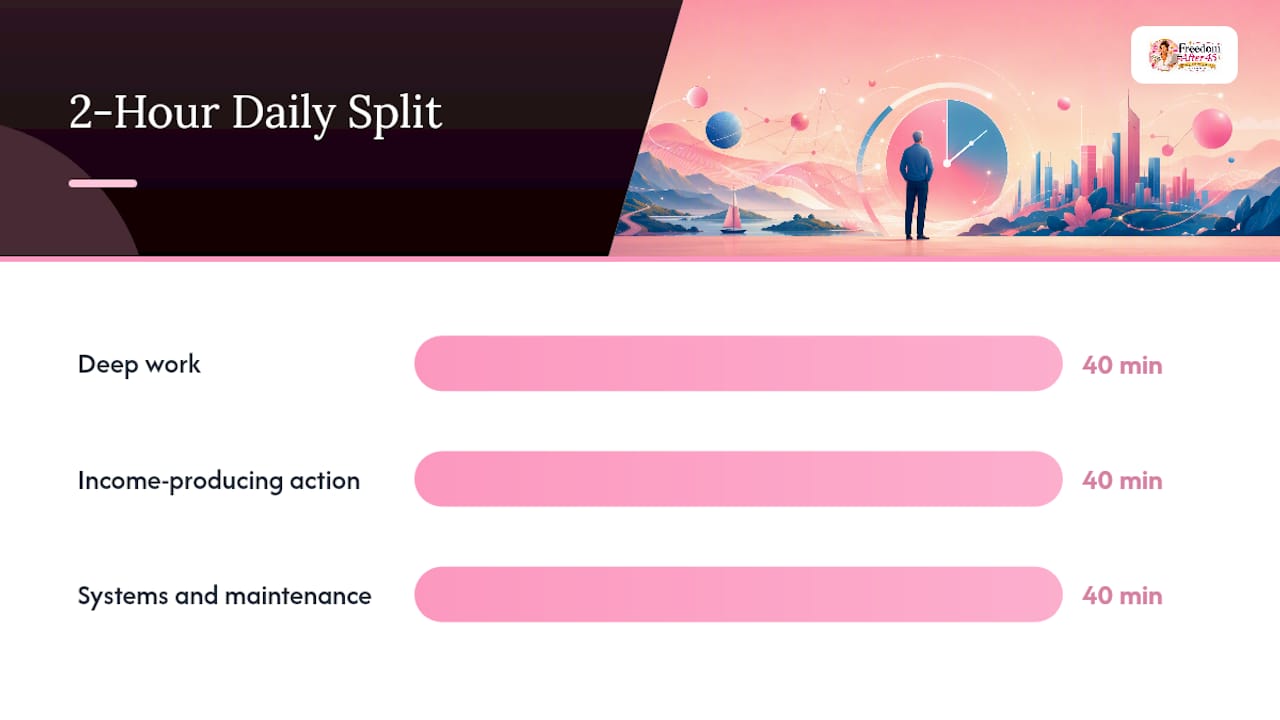
| Time Block | Focus | Example Task |
|---|---|---|
| — | Deep work | Build or refine your product |
| — | Income-producing action | Reply to buyers, post one offer, send one pitch |
| — | Systems and maintenance | Update pricing page, file receipts, plan tomorrow |
Weekly rhythm matters more than daily heroics. Theme days (product day, outreach day, admin day) and batching similar tasks cut the mental cost of switching gears and let solopreneurs scale revenue without adding hours.
- Treat your two hours as a calendar appointment, not a “when I get to it” task.
- Tell family members the block is off-limits, the same as a work shift.
- Turn off notifications during deep work; check messages only in the admin block.
Pro Tip: Do your hardest task in the first 20 minutes, before your brain finds an excuse.
Pro Tip: A protected one-hour block, done daily for months, beats an occasional four-hour weekend sprint every time.
What Tools Do You Need to Get Paid?
You can start for under $100 a month, often for free. Each platform below fits a different offer type.
- Gumroad: Best for one-time digital product sales like templates or guides, with built-in checkout.
- Substack: Best for a paid weekly or monthly email, handles subscriptions automatically.
- Etsy digital downloads: Best if you want built-in shopper traffic without marketing yourself.
- PayPal Subscriptions: Good for simple recurring billing if buyers already trust PayPal.
- Stripe Recurring: Best for a professional-feeling subscription or membership page.
Minimum setup checklist: one finished product file, one price, one connected payment account, one delivery link. That’s it.
Keep a simple folder of receipts and sales records from day one. Even small recurring income counts as taxable earnings, so basic bookkeeping now saves a headache later.

How Do You Test Demand Before You Overbuild?
A seven-day test tells you more than a month of planning.
- Day 1: Write down the exact problem your offer solves in one sentence.
- Day 2: Build the smallest usable version, not the polished dream version.
- Day 3: Set one price. Don’t overthink it.
- Day 4: Create your payment page on Gumroad, Substack, or Etsy.
- Day 5: Send it to 10 to 20 real contacts or a small email list.
- Day 6: Collect feedback, even if it’s just “would you buy this.”
- Day 7: Decide: scale it, tweak the offer, or drop it and try the next idea.
Low-ticket products let you practice selling and learn what resonates without a big upfront investment, which is exactly why starting small works better than an over-planned big launch.
If you get zero interest, change your price or your message before you assume the idea is dead. Test one variable at a time.
Pro Tip: Three “no thanks” and one “yes” is a working offer. Zero responses after 15 asks means it’s time to pivot.
How Should You Price and Project Your Recurring Income?
Three simple rules:
- Low-ticket entry point. Your first offer should be cheap enough that saying yes is easy, roughly $7 to $30.
- Recurring cadence. Weekly or monthly beats one-off, even at a lower price, because it compounds.
- Upsell path. Have a next-step offer ready for buyers who want more.
Raise your price once you have consistent repeat buyers and positive feedback. Add a second tier only after your first offer is selling reliably on its own.
A Reality Check on Fear, Money, and Momentum
Money fear, tech fear, time fear, and not knowing which direction to go all show up in the first month. That’s normal. Start smaller than you think you need to. Ship the imperfect version. Protect your two hours like an appointment you can’t cancel. The 2-Hour Workflow exists because most people don’t need more information, they need a system that removes the guessing.
How the 2-Hour Workflow Gets You to Your First Sale Faster
Most alternatives ask you to already have a following, a product, or hours of free time. The 2-Hour Workflow asks for none of that. It’s built specifically for women who are starting completely from zero.

The blueprint walks you through picking your offer, setting up payment and delivery, and running your first seven-day test, using the exact step-by-step structure covered above. It includes video instructions, real case studies from other women who started the same way, and a community for the days when you need a second opinion before hitting publish. If you’ve read this far and still feel stuck on which idea to pick, the workflow’s decision tools do that work for you.
Ready to stop planning and start your first two-hour block? Get the 2-Hour Workflow blueprint and follow the exact daily schedule that’s already helped thousands of families build steadier monthly income.
Sources
- Jenny’s show notes on starting small and avoiding big upfront costs (podcast episode)
- Over 50 and Starting Online 2026: Real Success Stories | EarnifyHub
- Daily Routine for Time-starved Online Entrepreneurs
- Time blocking for solopreneurs | Martin Ebongue
- The High-Income Time-Block: How Solopreneurs Protect Deep Work to Scale Revenue