

Best Weekend Side Hustles for Women 45+ Who Have 2 Hours a Day
The best weekend side hustles right now aren’t gig jobs or extra shifts. They’re low-tech digital products and evergreen affiliate funnels you can build in two hours a day and keep earning from long after the work is done. If you want recurring income instead of trading more hours for more dollars, this is the model that actually holds up.
Four options stand out for women starting from zero tech experience:
- Printable templates (planners, checklists, trackers) sold on Etsy or Gumroad
- Short guide PDFs or ebooks built from something you already know well
- Evergreen affiliate funnels paired with a simple email newsletter
- Mini courses or membership tiers hosted on Teachable or Thinkific
Each one turns a single weekend project into something that keeps selling on autopilot. The fastest way to put these into practice without guessing your way through platform setup is a structured system like the 2-Hour Workflow, which walks you through the exact sequence: pick a format, build the seed asset, and set up the funnel that sells it while you sleep.
The women who succeed at this fastest aren’t the most tech-savvy. They’re the ones who pick one format, follow a checklist, and stop second-guessing themselves after week two.
Key Takeaways
The most reliable weekend side hustles for women 45+ combine one evergreen digital product with an email-driven funnel built two hours a day.
| Point | Details |
|---|---|
| Pick one format | Choose printables, an ebook, an affiliate funnel, or a mini-course based on your strengths, not trends. |
| Build the seed asset first | One solid piece of content becomes templates, emails, and social posts through repurposing. |
| Capture emails from day one | An owned list protects your income if any single platform changes its rules. |
| Expect a realistic timeline | First sales typically land between 14 and 60 days with consistent two-hour sessions. |
| Follow a guided system | The 2-Hour Workflow provides the step-by-step checklist to move from idea to first sale. |
Table of Contents
- Why These Weekend Side Hustles Fit Women 45+ and a Two-Hour Rhythm
- Best Weekend-Friendly Methods and Who Each One Suits
- The 2-Hour Workflow: A Blueprint You Can Actually Follow
- Tools and Platforms You Actually Need to Start
- Realistic Timeline, Costs, and What to Expect
- An 8-Week Weekend-by-Weekend Plan
- Common Mistakes That Waste Weekend Time
- Real Results From Women Following This System
- What I’ve Learned Watching This Model Work
- How the 2-Hour Workflow Gets You There Faster
- Useful Resources to Explore Next
- Sources
Why These Weekend Side Hustles Fit Women 45+ and a Two-Hour Rhythm
These models work because they convert what you already know into something you sell once and deliver forever. A printable, an ebook, or a mini-course doesn’t need inventory, shipping, or a storefront staff. It needs to be made once and set up to sell repeatedly.
A few reasons this fits your situation better than most side hustle advice you’ve read:
- Low tech barrier. You don’t need to code, edit video professionally, or run ads to start.
- High margin. A $17 PDF guide costs you almost nothing to reproduce after the first sale.
- Evergreen funnels. Set up once, a funnel keeps working nights and weekends without your presence.
- You own the email list. Platforms change algorithms; your list stays yours.
- Time-boxed and realistic. Two hours fits before work, after dinner, or across a weekend morning.
Women over 50 also carry something the algorithm rewards: decades of judgment and lived experience that reads as authority the moment it hits a page. According to Lori Ballen’s guide for women over 50, building an email list from day one and prioritizing early traffic sources like Pinterest accelerates visibility long before you have a big following. That’s the opposite of what most “hustle” content assumes, and it’s exactly why this model suits you more than it suits a 22-year-old chasing viral content.
Best Weekend-Friendly Methods and Who Each One Suits
Pick based on your comfort level, not what’s trending. Here’s what each format actually involves and the first task to try this weekend.
- Printable templates. Digital planners, budget trackers, or meal-prep sheets sold as instant downloads. Best for organized former project managers, teachers, or anyone who loves systems. First task: design one printable in Canva and list it on Etsy.
- Short guide PDFs. A focused, 15 to 30 page guide solving one specific problem (organizing a move, planning a retirement budget, meal-planning for two). Best for writers, former HR professionals, or anyone with a niche skill. First task: outline five chapters based on a question people ask you often.
- Evergreen affiliate funnels. A landing page or newsletter recommending tools you already trust, tied to an email sequence. Best for former sales, marketing, or customer service professionals who know how to explain value. First task: pick three products you already use and outline one email about each.
- Mini courses or membership tiers. A short video course or a paid monthly newsletter delivering ongoing value. Best for former teachers, coaches, or consultants used to structured teaching. First task: record one 10-minute lesson on your phone covering your most-asked question.
The Automation Arbitrage framework describes this well: build a single knowledge asset, then layer affiliate links, a digital product, and a paid tier on top of it over time rather than launching all three at once.
The 2-Hour Workflow: A Blueprint You Can Actually Follow
The system that works is simple: seed one piece of content, repurpose it into smaller pieces, capture emails from it, then monetize the list. Everything below builds on that loop.
A daily two-hour session breaks down roughly like this:
- First 60 minutes: create. Write, record, or design one piece of your seed asset (a guide chapter, a template, a lesson outline).
- Next 30 minutes: repurpose. Turn that seed piece into a Pinterest pin, an email, or a short social post using free AI tools to speed up the rewrite.
- Final 30 minutes: capture and monetize. Update your landing page, respond to any emails, or check your Gumroad or Etsy dashboard for sales.
Here’s how that plays out across two months:
| Weeks | Focus | Expected Output |
|---|---|---|
| 1-2 | Build seed asset | First draft of ebook, template set, or course outline |
| 3-4 | Set up funnel | Landing page, opt-in offer, email welcome sequence |
| 5-6 | Launch and promote | Product live on Etsy/Gumroad, first Pinterest pins posted |
| 7-8 | Refine and repeat | First sales tracked, second product started |
One accelerated example from AI Success Lab’s 30-day build plan shows a builder launching Gumroad prompt packs by day 14 and landing first sales around day 21, with modest recurring income forming by day 60. That’s an aggressive pace, but it shows the mechanics are sound even on a compressed schedule.
Pro Tip: Batch your repurposing. Once your seed asset is done, spend one full session turning it into ten smaller pieces instead of repurposing piecemeal every day. It saves decision fatigue and keeps your two hours focused.
Tools and Platforms You Actually Need to Start
Pick platforms that match your method, not the ones with the most features. Overcomplicating your tech stack is the fastest way to burn a weekend without shipping anything.
- Etsy: best for printables and templates; listing fees run around $0.20 per item plus a small transaction cut.
- Gumroad: best for ebooks and digital downloads; no upfront cost, takes a percentage per sale.
- Teachable or Thinkific: best for mini-courses; free or low-cost starter tiers with paid upgrades as you scale.
- Canva: best for designing printables, covers, and social graphics; free tier covers most needs.
- ConvertKit or MailerLite: best for email capture and evergreen sequences; free up to a few hundred subscribers.
- Amazon Associates: best for affiliate links inside guides or newsletters; free to join.
- Printful: best for print-on-demand extensions of a printable brand; no upfront inventory cost.
- Shutterstock or Adobe Stock: best for stock images if you need visuals beyond Canva’s library; subscription or pay-per-image.
| Platform | Starting Cost | Best Use |
|---|---|---|
| Etsy | Under $5 to list first items | Printables, templates |
| Gumroad | Free | Ebooks, guides |
| ConvertKit/MailerLite | Free up to limits | Email list and funnels |
| Teachable/Thinkific | Free to low-cost tier | Mini-courses |
An email list is the one asset none of these platforms can take from you. As the Digital Product Business guide points out, starting on a marketplace like Etsy helps with discovery, but moving toward owned tools like an email list is what actually protects your income long term.
Realistic Timeline, Costs, and What to Expect
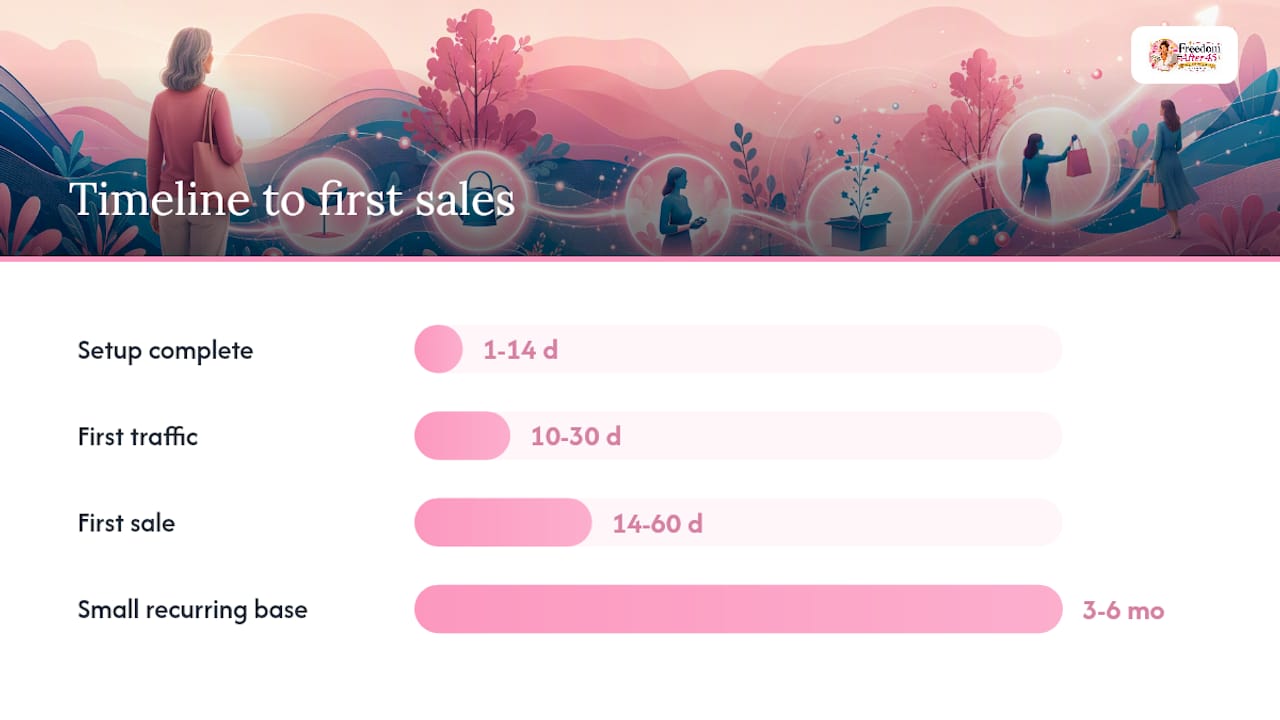
The honest answer: expect your first sale within a realistic timeframe ranging from a couple of weeks to a few months after you start, depending on your consistency. Faster results are possible but not typical.
| Milestone | Typical Timing |
|---|---|
| Setup complete (product + landing page) | Days 1 to 14 |
| First traffic (Pinterest, social, email) | Days 10 to 30 |
| First sale | Days 14 to 60 |
| Small recurring base (5 to 20 sales/month) | Months 3 to 6 |
Startup costs stay low. A domain runs about $12 a year, most email platforms are free under a few hundred subscribers, and marketplace fees are pennies per listing. Budget under $100 total for your first three months unless you choose paid ads, which isn’t necessary to start.
Earnings vary widely and nothing here is guaranteed. Some builders see a first $100 month; others take longer. For a broader financial cushion, pairing this with something like dividend-paying ETFs is one option worth exploring, as Forbes notes for women over 50 building a diversified passive-income base, though that’s a separate strategy from active digital product building.
An 8-Week Weekend-by-Weekend Plan
Here’s a realistic path using roughly two hours a day, most of it landing on weekends when your energy is highest.
- Weekend 1: Choose your format and outline your seed asset.
- Weekend 2: Draft the first half of your product (guide, printable set, or course script).
- Weekend 3: Finish the draft and design it in Canva.
- Weekend 4: Build a simple landing page and lead magnet opt-in.
- Weekend 5: Set up your email welcome sequence in ConvertKit or MailerLite.
- Weekend 6: Launch the product on Etsy or Gumroad and announce it to your list.
- Weekend 7: Build your follow-up email sequence and repurpose content for Pinterest.
- Weekend 8: Review early sales data, gather feedback, and start planning product two.
A simple daily template for these weekends: 60 minutes building, 30 minutes repurposing into smaller pieces, 30 minutes handling emails or platform setup. Track progress with a basic spreadsheet or even a paper checklist. On weekdays, 20 to 30 minute microtasks (answering one email, scheduling one pin, editing one paragraph) keep momentum without eating into your evenings.
Common Mistakes That Waste Weekend Time
Most weekend builders lose momentum not from lack of effort, but from overbuilding the wrong thing. Avoid these traps before they cost you a month.
- Overbuilding the first product. Launch a minimal version instead of a 100-page masterpiece nobody asked for.
- Chasing new tools every week. Pick one platform per function and stick with it for 90 days.
- Skipping the email list. A sale without a captured email is a lost second sale.
- Ignoring pricing research. Check what similar products charge before setting your price.
- Waiting for perfect before launching. A finished, imperfect product outsells a polished idea that never ships.
Watch for red flags too: any program promising guaranteed income, no-effort results, or pressure to buy within 24 hours is worth walking away from.
Pro Tip: Set a weekend timer. When your two hours are up, stop. Perfectionism is the biggest thief of momentum in this model.
Real Results From Women Following This System
Case one: A retired office manager spent her first two weekends outlining a budget-planning printable set. By week six she had it listed on Etsy; her first sale came on day 19.

Case two: A former teacher turned her lesson-planning process into a short PDF guide. She built her email list alongside the launch and saw her first ten sales within the first month, then a steady trickle of recurring buyers from referrals.
These are individual examples, not guarantees. Earnings vary by effort, niche, and consistency, and the 2-Hour Workflow program includes case studies like these to show what’s realistically achievable, not to promise identical results.
What I’ve Learned Watching This Model Work
The women who do best with this aren’t the ones with the flashiest ideas. They’re the ones who treat two hours a day as non-negotiable and resist the urge to build something more complicated than it needs to be. Experience is the advantage here, not a liability. Decades of knowing how to solve a real problem for someone else translates directly into a product people trust enough to buy.
Pick one idea from this list. Don’t wait until it feels perfect, and don’t try all four at once. Consistency across eight weekends beats a burst of effort followed by burnout.
How the 2-Hour Workflow Gets You There Faster
Building this alone means researching platforms, guessing at pricing, and hoping your funnel actually converts. The 2-Hour Workflow removes that guesswork with a step-by-step blueprint built specifically for women over 45 who want recurring income without an existing following or technical background.

The program includes:
- Video lessons covering each step of the seed-and-expand system
- Templates for landing pages, email sequences, and product outlines
- Real case studies from women who’ve built recurring income using this exact method
- Community support for troubleshooting and accountability
If you’ve read this far and still feel unsure where to start, that’s exactly the gap this program closes. Visit the 2-Hour Workflow program page to see the full breakdown and enroll at your own pace.
Useful Resources to Explore Next
- Etsy — best for listing printables and templates with low upfront fees.
- Gumroad — best for selling ebooks and guides with no listing cost.
- ConvertKit or MailerLite — best for building and automating your email funnel.
- Teachable or Thinkific — best for hosting a mini-course or paid membership tier.
Each resource solves a specific piece of the puzzle: platform fees stay low, setup guides are built into each tool, and distribution becomes manageable once your email list is in place.
Sources
- Best passive income strategies for women over 50 who want to retire rich
- How to Build a Digital Product Business in 2026 (The Complete Guide)
- Passive Income With AI (30-Day Build Plan 2026) | AI Success Lab Blog
- The Automation Arbitrage: How to Use AI to Create a System That Earns While You Sleep Without Building a Single Product