

Vet Online Income Offers in 30 Minutes and Report to the FTC
There is no such thing as guaranteed easy income online. If an offer promises fixed earnings, asks for payment before you start, or pressures you to decide fast, treat it as a scam until proven otherwise. Verify the company before you pay or share financial information, and if something already feels wrong, report it at Reportfraud or ic3.gov.
TL;DR:Scams often claim guaranteed earnings, pressure immediate decisions, and require upfront payments through non-reversible methods like gift cards or wire transfers.Verify online income opportunities by researching complaints, confirming payment structures, and ensuring the business has a legitimate registration and contact info.Use credit cards or escrow platforms for payments while avoiding untraceable methods, and keep financial and personal data secret until legitimacy is confirmed.Act quickly and thoroughly if targeted, by freezing accounts, changing passwords, and reporting to authorities like the FTC and FBI’s IC3.Reporting scams with detailed evidence helps authorities detect and shut down fraudulent schemes more effectively.
Table of Contents
- Top Red Flags That Signal an Income or Passive-Income Scam
- How to Vet an Online Income Opportunity in 30 Minutes or Less
- Safe Payment and Communication Practices That Protect Your Money
- If You Think You Were Targeted or Scammed, Act in This Order
- Where to Report Scams and Find Official Help
- A Safer Way to Build Online Income Without the Guesswork
- Sources
Top Red Flags That Signal an Income or Passive-Income Scam
Scammers rely on a small set of tricks that work over and over because they play on hope and urgency. The Federal Trade Commission has pursued operations that collected tens of millions of dollars from people chasing exactly this kind of promise, and the pattern behind those cases repeats across almost every online income scam you’ll encounter.
Watch for these signals before you engage with any opportunity:
- Guaranteed earnings or a “risk-free” income claim. No legitimate business can promise specific results, because real income depends on market conditions, effort, and skill.
- Pressure to act immediately. Countdown timers, “limited spots,” and urgent follow-up calls exist to stop you from researching.
- Upfront fees dressed up as training, starter kits, or refundable deposits. A defining pattern of these scams is that the offer asks you to pay first, when a legitimate opportunity pays you.
- Referral-only income models, where the real money comes from recruiting others rather than selling a product or service.
- Vague explanations of how the money is actually made. If nobody can clearly say who pays you, how much, and when, that vagueness itself is the warning.
Pro Tip: Ask the person recruiting you to write down, in plain language, exactly how and when you’d get paid. Scammers stumble here almost every time, because the model only works if the details stay fuzzy.
How to Vet an Online Income Opportunity in 30 Minutes or Less
Before you commit a dollar or a Social Security number, run this checklist. It takes less time than most job applications.
- Search the company name plus “scam,” “complaint,” or “review.” Check both the first page of results and any consumer forums that show up.
- Check the FTC’s site and your state attorney general’s consumer complaint page for existing warnings or legal actions.
- Confirm who pays whom, and when. Legitimate work pays you for output delivered, not for signing up.
- Refuse any offer that requires payment before you can start earning, whether it’s framed as a kit, license, or training fee.
- Verify the business is real. Look for a registered business name, a physical address that checks out on a map, and contact information that isn’t just a personal cell number.
- Independently confirm testimonials and press mentions. Search the exact wording of a “review” or the name of a “featured in” outlet; recycled or fabricated praise is common in these schemes.
If you can’t complete this checklist in half an hour because information is missing or contact attempts go unanswered, that’s your answer.
Safe Payment and Communication Practices That Protect Your Money
The payment method a company insists on tells you almost everything about its intentions.
Avoid these entirely for any new online relationship:
- Gift cards (Amazon, Apple, Google Play, or otherwise)
- Wire transfers through services like Western Union or MoneyGram
- Prepaid cash reload cards
- Unsolicited requests to send cryptocurrency
None of these can be reversed once sent, which is exactly why scammers ask for them. A credit card or a reputable escrow platform gives you dispute rights a gift card never will.
Keep bank account numbers, Social Security numbers, and photo ID copies private until you’ve confirmed legitimacy through the steps above. The FBI also recommends multi-factor authentication and unique passwords for any account tied to money, and skipping financial logins on public Wi-Fi. Many income scams start as phishing messages that mimic a real company and ask you to “verify” payment details through a link. No legitimate employer needs you to click a link to confirm your bank account.
If You Think You Were Targeted or Scammed, Act in This Order
Speed matters here more than almost anything else you’ll do.
- Call your bank or credit card company immediately to freeze the card, reverse a pending charge, or flag the account.
- Change your passwords and turn on multi-factor authentication on any account that shares a password with the compromised one.
- Report the scam at Ftc and file a complaint with the Internet Crime Complaint Center at ic3.gov.
- If you shared a Social Security number, ID, or other personal data, go to Identitytheft for a step-by-step recovery plan built around your specific situation.
While you work through those steps, also do the following:
- Consider a credit freeze with the three major credit bureaus if identity theft is a real possibility.
- Contact your state attorney general’s consumer protection office; some states can act faster on local scam patterns than federal agencies.
- Save every message, email header, payment receipt, and screenshot connected to the scam before you delete anything.
Where to Report Scams and Find Official Help
Reporting isn’t just paperwork. The FTC and IC3 use complaint patterns to open investigations and enforcement actions, so your report can help stop the next person from losing money to the same operation.
Keep these resources bookmarked:
- Reportfraud — the FTC’s main portal for reporting scams, fraud, and bad business practices.
- IC3.gov — the FBI’s Internet Crime Complaint Center, best for anything involving online payment fraud or hacking.
- Identitytheft — for personalized recovery plans when your identity or personal data has been compromised.
- Consumer.ftc.gov — background guidance on recognizing scam patterns before you’re targeted.
| Where to report | Best for |
|---|---|
| ReportFraud.ftc.gov | Any income, job, or business opportunity scam |
| IC3.gov | Online payment fraud, hacking, phishing |
| IdentityTheft.gov | Stolen Social Security number, ID, or bank data |
| State attorney general | Local businesses, unresponsive federal follow-up |
Before you file, gather screenshots, payment confirmations, names or usernames used by the scammer, and any phone numbers or email addresses involved. The more specific your report, the more useful it is to investigators.
A Safer Way to Build Online Income Without the Guesswork
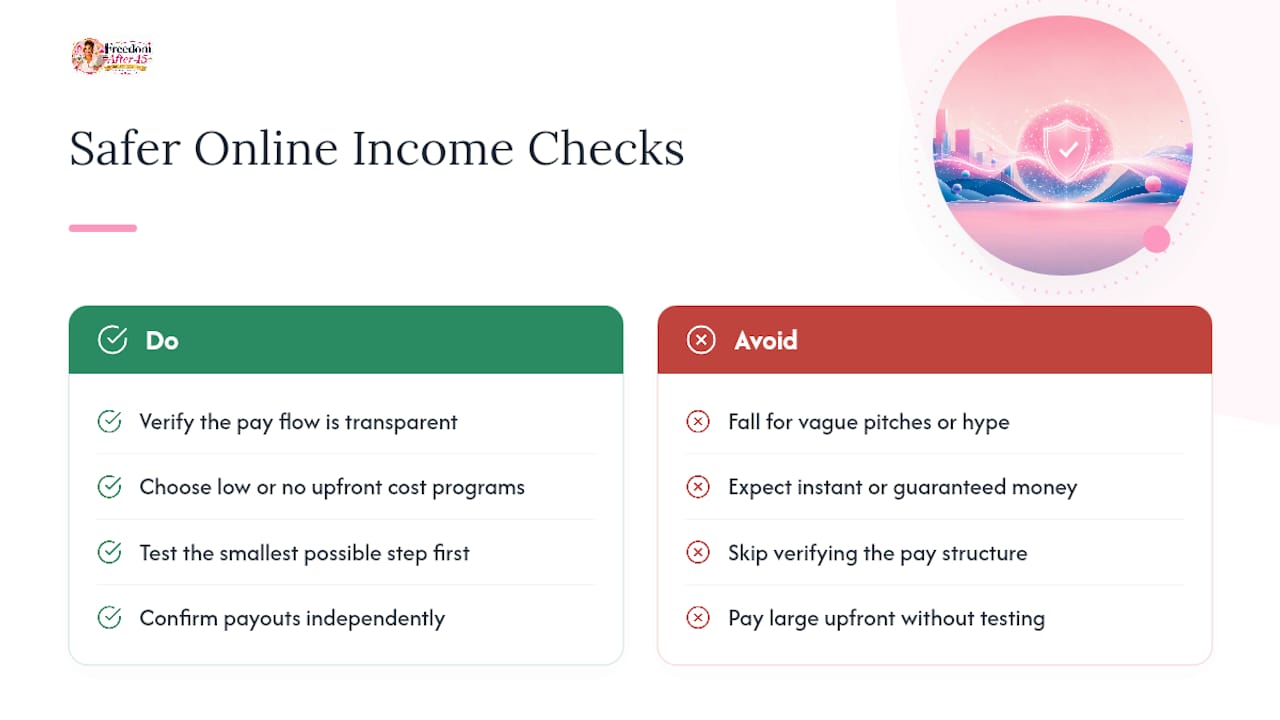
Legitimate income paths share a few traits scams never manage to fake convincingly: transparent pay flow, low or no upfront cost, and payouts you can verify independently rather than take on faith. None of that means instant or guaranteed money. Real online income still takes consistent time and realistic expectations, not a countdown timer.
Freedom After 45 built its 2-Hour Workflow around that same transparency standard, laying out exactly what the daily time commitment looks like and how income is generated, step by step, without requiring an existing following or product of your own. Before committing to any paid program, including this one, test the smallest possible step first and confirm the pay structure makes sense to you. You can review the full workflow breakdown to see how the model compares to the vague pitches covered above.
— Freedom After 45